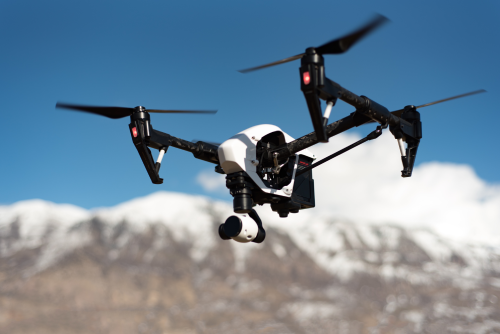
Mining and quarry sites need frequent, reliable measurements, but many areas are large, dusty, steep, or simply unsafe to walk. That is why drones are now widely used in mining and quarry surveys: they can capture detailed aerial data quickly and turn it into maps, 3D models, and volume reports that managers can use for planning, production tracking, and safety checks.
Quick Take
- Drones are most useful in mining and quarry surveys for topographic mapping, stockpile volume measurement, pit progress tracking, face inspection, haul-road checks, and environmental monitoring.
- A good drone survey is not just flying and taking photos. It needs proper planning, safe site coordination, accurate control points or RTK/PPK positioning, and careful processing.
- For many open sites, RGB photogrammetry works well. LiDAR can be better where vegetation, low-texture surfaces, or bare-earth terrain capture are important.
- Drones save time and reduce exposure to risky ground conditions, but they do not replace every ground survey task.
- In India, always verify the latest DGCA and Digital Sky requirements, site permissions, and any statutory survey or certification rules before operating.
What a mining or quarry survey usually needs
A mine or quarry survey is not just a one-time map.
Most sites need repeated measurements for:
- pit and bench mapping
- stockpile and overburden volume calculation
- haul-road and dump monitoring
- excavation progress tracking
- drainage and erosion checks
- lease boundary and land-use documentation
- safety reviews of steep or unstable areas
Traditional survey methods using total stations, GNSS receivers, or manual cross-sections are still important. But walking every stockpile, bench edge, or dump slope takes time and can expose crews to loose rock, traffic, dust, and unstable ground.
That is where drones fit best. They collect a large amount of site data in one mission, and that same workflow can be repeated weekly or monthly for clean comparison over time.
How drones are used in mining and quarry surveys
Topographic mapping of the whole site
One of the most common uses is building an updated topographic map of the mine or quarry.
A drone flies a planned grid, captures overlapping images, and software turns those images into:
- an orthomosaic, which is a corrected top-down image map
- a point cloud, which is a dense 3D set of measured points
- a digital surface model, or DSM, showing the site surface
- contours and cross-sections for planning and design
This is useful for open-cast mines, stone quarries, crusher yards, overburden dumps, haul roads, settling ponds, and plant surroundings.
For example, a quarry operator may want a monthly site map showing the current pit edge, bench layout, stockyard arrangement, and road condition. A drone can capture that in a fraction of the time needed for full ground coverage.
Stockpile and overburden volume measurement
This is often the fastest way for drones to deliver business value.
Instead of estimating pile size visually or relying on sparse measurements, a drone can model the full 3D shape of a stockpile. Survey software then calculates volume based on the selected base surface.
Typical materials include:
- crushed stone
- aggregates
- coal
- limestone
- iron ore
- sand
- overburden
- processed mineral stock
This helps with:
- production reconciliation
- dispatch planning
- contractor billing support
- inventory tracking
- checking whether reported material movement matches actual site change
For small quarries in India, even one regular stockpile survey can improve decision-making because inventory errors directly affect cash flow.
The important point is that a volume result is only as good as the method. Clear pile boundaries, correct base definition, and repeatable survey timing matter more than flashy 3D visuals.
Pit progression and production monitoring
Mining and quarrying are dynamic. Faces move, benches change, dumps rise, and roads get rerouted.
By repeating the same drone survey at fixed intervals, site teams can compare datasets and answer practical questions such as:
- How much did the pit advance this month?
- Which bench areas were cut or filled?
- Has the dump slope become steeper?
- Is the quarry expanding within the intended working zone?
- Are haul roads getting wider, narrower, or rougher?
This is especially useful for owners, contractors, and head offices that want visual proof of progress rather than only spreadsheet figures.
A comparison between two surveys can show cut-and-fill changes, new excavation extents, and production trends much more clearly than ground notes alone.
Bench, highwall, and quarry face inspection
A highwall is the steep exposed wall of a mine or quarry. In a hard-rock quarry, the working face may also have cracks, loose rock, or uneven benches that are unsafe to approach closely.
Drones help by capturing close but controlled views of:
- bench widths
- crest and toe condition
- rockfall indicators
- erosion channels
- scaling needs
- access routes near steep faces
This is useful for survey teams, geotechnical staff, and mine planners who need updated surface information without sending people onto unstable ground.
Important caution: a drone inspection supports decision-making, but it does not replace a qualified geotechnical assessment where one is required.
Haul-road, ramp, and drainage assessment
Haul roads affect safety, fuel use, tire wear, and production speed. Drainage affects slope stability, sediment movement, and monsoon performance.
A drone survey can show:
- road width consistency
- berm condition
- potholes or rutting
- ponding water
- blocked drains
- erosion channels
- culvert or ditch changes
- low points where runoff collects
Cross-sections and surface models help teams see whether a road profile is still within the intended shape. In Indian conditions, this becomes especially valuable before and after the monsoon, when drainage failures can quickly disrupt operations.
Environmental and compliance documentation
Many mining and quarry operations need periodic visual and spatial records for internal review, consultants, or reporting.
Drone datasets can support:
- land disturbance tracking
- dump stability monitoring
- silt pond or sediment trap observation
- rehabilitation or reclamation progress
- green-belt and plantation monitoring
- boundary and land-use review
This does not mean every drone map is automatically acceptable for official submission. If a report must follow a specific format, coordinate system, or certification process, confirm that requirement in advance.
Safety planning and inaccessible zone checks
Some parts of a mine site are simply poor places for people to stand.
Drones help inspect:
- steep dump slopes
- waterlogged edges
- recently blasted areas after clearance
- isolated corners of a large lease
- areas near conveyors or crushers where access is limited
Even where a detailed ground survey is still needed later, the drone can act as a first-look tool that reduces unnecessary exposure.
Common outputs from a drone mine survey
| Output | What it means | Typical use |
|---|---|---|
| Orthomosaic | Corrected top-down image map | Site layout, visual inspection, documentation |
| Point cloud | Dense 3D representation of the surface | CAD work, terrain analysis, face review |
| DSM | Surface model including ground and objects | Overall site shape, drainage review |
| DTM | Bare-earth terrain model after filtering | Contours, cut-fill, planning |
| Contours and cross-sections | Elevation lines and profile slices | Bench design, road grading, slope review |
| Volume report | Measured quantity of cut, fill, or stockpile | Inventory, reconciliation, planning |
The typical drone survey workflow on a mine site
A strong result usually follows a predictable process.
1. Define the survey question first
Before anyone flies, decide what the site actually needs.
Examples:
- monthly stockpile volumes
- updated quarry topography
- pit progression comparison
- haul-road condition review
- highwall inspection
This decides the flight pattern, sensor choice, control method, and output format.
2. Review safety and site operations
Mine sites are active industrial environments.
The drone team should coordinate with site staff on:
- blasting schedules
- vehicle movement
- restricted areas
- crusher and conveyor zones
- dust conditions
- weather and wind
- emergency procedures
Flying at the wrong time can create both safety and data problems.
3. Set control and checkpoints if needed
For accurate mapping, the team may use:
- ground control points, or GCPs
- independent check points
- RTK or PPK positioning on the drone
RTK means real-time kinematic positioning. PPK means post-processed kinematic. Both improve positional accuracy, but they do not remove the need for validation.
If the survey will feed engineering or reporting work, checkpoints are especially important.
4. Plan the flight for the terrain
A quarry is not a flat field.
The flight may need:
- higher overlap
- terrain awareness
- oblique images for steep faces
- lower altitude over smaller details
- separate missions for stockpiles and broad site mapping
If the site has tall benches, very deep pits, or sharp elevation changes, a generic grid flight may not be enough.
5. Capture data consistently
Repeat surveys should be flown as consistently as possible.
That means keeping an eye on:
- similar altitude or ground resolution
- similar overlap
- stable light where possible
- limited motion blur
- minimal dust obscuring the scene
Consistency is what makes month-to-month comparison meaningful.
6. Process the data properly
The imagery or LiDAR data is then processed into models and maps.
Key steps may include:
- image alignment
- point cloud creation
- surface generation
- georeferencing
- filtering for terrain
- stockpile boundary creation
- volume calculation
- export to CAD or GIS formats
This is where many errors happen if the operator is inexperienced.
7. Validate the results
Do not assume the software output is automatically correct.
A good survey workflow checks:
- control point errors
- checkpoint errors
- missing zones
- poor reconstruction near steep faces
- wrong pile boundaries
- suspicious spikes or holes in the surface
This is the difference between a useful survey and a pretty graphic.
8. Deliver outputs people can actually use
A quarry manager may need a volume table.
A survey consultant may need a point cloud and contours.
An operations team may need a marked orthomosaic.
The best service providers deliver the right format for the user, not just screenshots.
Choosing the right drone setup
Not every mine survey needs the same type of aircraft or sensor.
| Setup | Best for | Strengths | Limits |
|---|---|---|---|
| Small multirotor with RGB camera | Small quarries, stockpiles, inspections | Simple deployment, detailed capture | Shorter flight time, less coverage |
| Enterprise multirotor with RTK/PPK | Regular survey work and repeat mapping | Better positioning, consistent results | Slower for very large areas |
| Fixed-wing survey drone | Large open mines and long corridors | Covers more area quickly | Needs launch/recovery space, less flexible near faces |
| LiDAR-equipped system | Vegetation, complex terrain, bare-earth needs | Better penetration through sparse cover, strong terrain capture | Higher cost, heavier workflow |
For many quarry jobs, an RGB photogrammetry setup is the practical starting point. LiDAR becomes more attractive when vegetation, low-texture terrain, or specific terrain modeling demands make photogrammetry less reliable.
Accuracy: what matters in the real world
The right question is not “Are drones accurate?” but “Accurate enough for what purpose, and how was that accuracy checked?”
Accuracy depends on:
- camera quality and calibration
- flight altitude and image resolution
- overlap
- site geometry
- control points or RTK/PPK quality
- processing workflow
- how stockpile bases are defined
- independent checkpoints
For recurring volume surveys, consistency is often as important as raw absolute accuracy. If the same method is repeated properly, trend analysis becomes more useful.
For legal boundaries, engineering setout, or statutory submissions, ground survey control is still critical. In some cases, drone outputs may need supervision or certification by a qualified survey professional. Verify that before using the data for official purposes.
A practical tip: when hiring a service provider, ask for the control method, checkpoint method, coordinate system used, and an accuracy report, not just the final map.
Where drones still have limits
Drones are powerful, but they are not perfect.
They may struggle with:
- underground mines and tunnels using standard GPS-based workflows
- overhangs and undercuts that are not visible from above
- reflective water surfaces
- uniform low-texture areas
- heavy dust or haze
- dense vegetation covering the ground
- deep narrow pits with poor satellite visibility
A drone map can also miss the true base of a stockpile if surrounding ground is cluttered or poorly captured.
In these cases, the answer is often a mixed workflow: drone data plus GNSS, total station, ground checks, or LiDAR where appropriate.
Safety, legal, and compliance in India
Mining and quarry sites are private work areas, but that does not mean drone operations are automatically allowed.
Before flying in India, verify the latest position on:
- DGCA operating requirements
- Digital Sky permissions or approvals where applicable
- airspace restrictions around the site
- NPNT and platform compliance where relevant
- pilot competency or training requirements
- insurance expectations for commercial work
- local site SOPs and owner permission
Also remember:
- coordinate with the mine manager or safety officer before every mission
- do not fly during blasting activity or in unclear blast windows
- avoid flying directly over workers unless absolutely necessary and permitted
- watch for power lines, crushers, conveyors, and heavy truck routes
- dust can affect visibility, sensor quality, and aircraft reliability
- maintain clear takeoff and landing areas away from active machinery
If the survey output will be used for lease boundary matters, formal reporting, mine planning submissions, or legal disputes, confirm whether a licensed surveyor, authorized mining surveyor, or other qualified professional must verify or certify the results.
Rules and procedures can change, so always check current official guidance before operating.
Common mistakes in mining and quarry drone surveys
Treating the drone like a camera, not a measuring tool
A cinematic flight may look impressive but still produce poor survey data. Measurement missions need overlap, control, and planning.
Skipping checkpoints
RTK alone is not a substitute for proper validation on important jobs.
Using the wrong model type
A DSM includes everything on the surface. If you need bare-earth terrain, you may need a DTM. Using the wrong one can distort contours and volumes.
Poor stockpile boundary definition
Even a good 3D model gives wrong numbers if the pile toe or base is marked badly.
Flying in heavy dust or harsh mid-operation conditions
Dust softens image detail and can create gaps in reconstruction. Sometimes the best survey window is before work starts or during a planned pause.
Ignoring steep-face geometry
A straight overhead grid may not capture vertical or near-vertical quarry faces well. Oblique imagery or separate inspection passes may be needed.
Changing the method every month
If you want progress comparison, keep the workflow as consistent as possible.
Delivering data no one on site can use
A 3D mesh is not helpful if the client really needs a simple volume table and an updated orthomosaic.
FAQ
Are drones accurate enough for mining stockpile volumes?
Yes, often they are, especially for open stockpiles with good visibility and a proper workflow. But accuracy depends on control, flight planning, processing, and base definition. Always ask how accuracy was checked.
What is better for quarry surveys: photogrammetry or LiDAR?
Photogrammetry is usually the practical choice for open, visible quarry surfaces and stockpiles. LiDAR is stronger where vegetation, low texture, or terrain filtering make photo-based mapping harder. The right answer depends on the site and the output needed.
Can a small consumer drone be used for quarry surveys?
It can capture basic visuals and, in some cases, simple models for internal reference. But for repeatable professional survey work, better positioning, stronger operational reliability, and a validated workflow are usually more important than low cost alone.
How often should a mine or quarry be surveyed by drone?
That depends on site activity. Fast-changing quarries may benefit from weekly or fortnightly stockpile surveys, while broader topographic updates may be monthly or quarterly. Start with the decisions you need to make, then set the survey frequency around them.
Do drones replace total stations and GNSS survey teams?
No. Drones reduce field time and improve coverage, but ground survey tools are still essential for control, validation, setout, and certain legal or engineering tasks. In most serious operations, drones complement ground surveying rather than replace it.
Is RTK enough, or do I still need ground control points?
RTK improves results, but it does not automatically remove the need for checkpoints or control. On high-stakes jobs, ground control and independent checks still matter. The right approach depends on the required confidence level.
Can drones help with blast planning or face assessment?
They can help by providing updated surface models and visual records of benches and faces before planning. But actual blast design and safety decisions should always remain with qualified professionals following site procedures.
Are special permissions needed in India for mining drone surveys?
Potentially, yes. Site ownership alone is not enough. You must verify current DGCA, Digital Sky, airspace, platform, and operational requirements before flying. Requirements can change, so check the latest official guidance.
What should I ask a drone survey provider before hiring them?
Ask about: – experience on mines or quarries – control and checkpoint method – expected outputs – repeat survey consistency – safety procedure on active sites – turnaround time – coordinate system and deliverable format – whether they can provide an accuracy report
Final takeaway
If you are considering drones for mining or quarry surveys, start with one repeatable job that clearly saves time or money, such as monthly stockpile volumes or pit progress mapping. Then build around accuracy checks, safe site coordination, and current Indian compliance requirements. Done properly, a drone becomes far more than a flying camera; it becomes a practical measurement tool for faster, safer, and better-informed site decisions.
