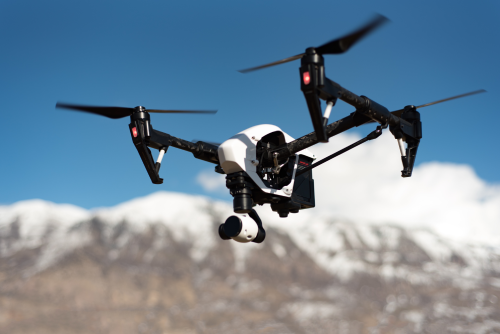
Drones are increasingly used in airport perimeter monitoring to help security teams watch long boundary lines, inspect fences, and respond faster to alerts. They do not replace CCTV, access control, or patrol vehicles, but they add a fast aerial view that can cover far more ground in minutes. In India, this is a specialised and tightly controlled use case, not something hobby pilots should ever attempt near an airport.
Quick Take
- Airport perimeter monitoring means watching the outer boundary of the airport: fence lines, walls, gates, patrol roads, remote corners, and nearby vulnerable edges.
- Drones are most useful for rapid verification, night checks, fence inspection, post-weather assessment, and coverage of hard-to-reach areas.
- The best setups usually combine a normal daylight camera, optical zoom, and sometimes a thermal camera for low-light work.
- Drones work best as part of a larger security system with CCTV, intrusion alarms, control-room staff, and ground response teams.
- They save time, reduce blind spots, and improve situational awareness, but they also have clear limits such as battery life, weather, communications reliability, and strict approvals.
- In India, any drone operation in or near an airport requires formal coordination and compliance. Always verify the latest DGCA, Digital Sky, airport operator, airspace, and security requirements before planning or buying.
What airport perimeter monitoring actually includes
When people hear “airport security,” they often think only about terminals and passenger screening. But perimeter monitoring is a different job.
It focuses on the outer edge of the airport and the areas that affect boundary security, such as:
- boundary fences or compound walls
- gates and controlled entry points
- perimeter roads used by security vehicles
- open land along the airport edge
- drainage lines, uneven terrain, or low-visibility corners
- sections affected by vegetation, waterlogging, or construction activity
- places where animals, vehicles, or unauthorised people may approach the boundary
At many Indian airports, this outer boundary can run for several kilometres. Some stretches may be easy to patrol by vehicle, while others may be dark, muddy, isolated, or hard to inspect quickly after heavy rain.
That is where drones become useful. They give the security team a temporary aerial viewpoint exactly where it is needed, instead of relying only on fixed cameras or slow ground checks.
Why airports add drones to the security mix
Perimeter monitoring has one basic challenge: the area is large, but the response time must be short.
A fixed camera is always available, but it only sees one direction. A patrol vehicle can investigate physically, but it needs time to reach the spot. A drone can launch quickly, fly to the area of concern, and send live video back to the control room.
That makes drones especially valuable when the team needs to answer one question fast: “What is actually happening there?”
Here is the practical difference:
| Security tool | Best at | Main limitation | Best role |
|---|---|---|---|
| CCTV | Continuous watch over fixed locations | Blind spots and fixed angles | Baseline monitoring |
| Ground patrol | Physical inspection and intervention | Slower over long distances | On-ground response |
| Drone | Rapid aerial verification and wide visual coverage | Limited flight time and strict operating controls | Fast situational awareness |
The key point is simple: drones are not the whole perimeter security system. They are the fast-response aerial layer.
How drones are used in airport perimeter monitoring
Routine perimeter patrols
Some airports use drones for planned checks of specific boundary sectors.
Instead of sending a vehicle along every stretch, the team can fly an approved route to look for:
- damaged fence sections
- open or poorly secured gates
- unusual movement near the boundary
- objects placed close to the fence
- signs of digging, tampering, or physical damage
- lighting failures in selected sectors
This can be useful early in the morning, before night shift handover, or after weather events.
For example, after a night of strong wind and rain, a drone can help inspect multiple outer sectors much faster than a full vehicle-based sweep.
Alarm verification
This is one of the most practical airport perimeter uses for drones.
If a motion sensor, vibration sensor, or CCTV operator flags a suspicious event, the drone can be launched to verify the alert before multiple teams are sent.
That matters because not every alert is a real intrusion. It could be:
- an animal near the boundary
- maintenance activity
- vegetation moving in wind
- a patrol team already in the area
- an object that looks suspicious from a fixed camera but is harmless
A drone gives:
- an overhead view
- a different angle from the fixed camera
- the ability to zoom in from a safer distance
- live information for the control room and response team
This helps reduce false alarms and improves response quality.
Night and low-light monitoring
Many perimeter problems are harder to assess after dark. Even with floodlights, some areas remain dim or have uneven lighting.
A drone with a thermal camera can detect heat differences and help spot people, vehicles, or animals in low light. Thermal does not always give a clear identity, but it is very useful for detection and search.
A common real-world use is this:
- A control room receives an alert from a remote perimeter sector late at night.
- A drone is sent to the area.
- The thermal view shows whether the movement is human, animal, or nothing significant.
- Ground teams are directed only if needed.
This can save time and reduce unnecessary deployment.
Fence and wall inspection
Airport perimeter security is not only about detecting people. It is also about maintaining the physical barrier.
Drones are often used to inspect:
- fence alignment
- broken or bent sections
- damaged posts
- collapsed wall portions
- growth of vegetation along the boundary
- erosion or waterlogging near the fence base
This is especially relevant in India during and after the monsoon, when drainage problems, mud, pooling water, and soft ground can affect boundary integrity.
A drone inspection does not replace a physical repair team, but it helps the airport find the exact sectors that need attention.
Monitoring hard-to-reach stretches
Some parts of an airport boundary are awkward for vehicle patrols. The ground may be uneven, narrow, wet, or obstructed.
In such cases, a drone can check the area without putting staff into a slow or risky search pattern.
This is particularly useful for:
- marshy edges
- drainage channels
- isolated corners
- stretches with poor vehicle access
- large open areas where one patrol vehicle has limited visibility
For big airfields, this can significantly cut the time needed to understand the situation.
Animal and wildlife awareness near the boundary
Animals near the perimeter can create both security and operational concerns.
Depending on the airport environment, the issue might involve stray animals, livestock near the boundary, or movement in open land adjoining the airport edge. Drones can help locate the source of the issue quickly and guide the appropriate ground team.
This is not the same as full wildlife management, which is a broader airport safety function. But for perimeter awareness, a drone can be a useful detection and verification tool.
Incident documentation and review
After a perimeter incident, airports may use drones to document the affected area for internal review, maintenance planning, and security analysis.
This helps teams answer questions like:
- Where exactly did the event happen?
- Was the barrier damaged?
- How accessible was the location?
- Did lighting, terrain, or visibility contribute to the issue?
- What should be improved in patrol or camera placement?
That makes the drone useful not just during the incident, but after it as well.
A typical airport perimeter drone workflow
The most effective airport drone operations are built around workflow, not just hardware.
A common process looks like this:
-
An alert or inspection task is created
This may come from CCTV, a sensor, a patrol report, or a planned maintenance check. -
Authorisation and coordination are confirmed
Because airports are sensitive airspace, drone deployment must happen under approved procedures with the required operational coordination already in place. -
The drone launches from a designated safe point
The launch area, route, operating height, and recovery plan should already be defined in the airport’s standard operating procedure. -
Live video is shared with the control room
Security staff watch the feed, mark the location, and assess whether the situation needs ground intervention. -
Ground teams respond based on verified information
Instead of going in with limited visibility, they move with clearer visual context. -
The mission is logged and reviewed
Video, flight logs, observations, and follow-up actions are recorded for audit, maintenance, or training.
This is why many airports treat drone monitoring as a control-room tool, not as a standalone flying gadget.
What kind of drones and sensors are usually used
The right platform depends on the mission.
Multirotor drones
These are common for airport perimeter monitoring because they:
- launch quickly
- hover over a specific point
- inspect fences and gates closely
- work well for alarm response
- need less space than larger aircraft
Their biggest weakness is shorter flight endurance.
Fixed-wing or hybrid VTOL drones
Some long-perimeter operations may consider fixed-wing or hybrid VTOL systems for longer endurance.
They can cover more distance, but they are usually more complex to deploy and are less convenient for close hovering inspection. They are generally better suited to larger-area surveillance programmes than quick-response fence checks.
Payloads that matter most
For perimeter monitoring, the most useful payload features are usually:
- Daylight camera for normal visual observation
- Optical zoom for closer inspection without flying too near the subject
- Thermal camera for low-light detection
- Stable video link for real-time decision-making
- Reliable positioning and safety systems suited to controlled operations
Some advanced systems also add video analytics, object tracking, or software that helps mark and share the location of a detected event. These features can help, but they do not remove the need for trained human judgment.
Why this use case makes sense in India
Airport perimeter monitoring with drones can be especially relevant in Indian conditions because airports often deal with a mix of challenges:
- long boundary lengths
- nearby urban growth
- open land around outer sectors
- monsoon-related fence and ground damage
- heat haze, dust, and uneven visibility
- remote segments that are slower to patrol physically
- mixed terrain where fixed cameras do not cover every angle well
In these conditions, a drone can provide quick extra visibility without building permanent camera infrastructure everywhere.
For airport operators and security integrators, that can make drones attractive as a flexible layer rather than a full replacement project.
Limits: what drones cannot do well
The value of drones is real, but so are the limits.
They are not ideal when people expect them to solve every security problem. Common limits include:
-
Limited flight time
Most drones cannot stay airborne continuously for an entire shift without swaps, multiple aircraft, or special systems. -
Weather sensitivity
Heavy rain, strong wind, poor visibility, and extreme heat can affect safety and performance. -
Communications and positioning challenges
Large metal structures, interference, or difficult operating environments can affect navigation and control quality. -
Not a constant watch tool by themselves
CCTV watches continuously. A drone only watches while it is flying. -
Thermal has limits
It helps detect heat, not always identity. It can support assessment, but not replace a full security judgment. -
False confidence from automation
AI-based detection can assist, but it still produces false alarms and needs human review. -
Higher operating discipline
Batteries, maintenance, crew training, checklists, and data handling all matter more than many first-time buyers expect.
In short, drones are excellent for selective aerial response, not for replacing the entire perimeter security system.
Safety, legal, and compliance considerations in India
This is the most important section.
Airports are highly sensitive airspace environments. Any drone operation in or around an airport requires serious planning, formal approval, and close coordination. This is not a normal commercial drone job, and it is never a recreational flying activity.
Before any airport perimeter monitoring programme is planned in India, operators should verify the latest official requirements related to:
- DGCA rules and guidance
- Digital Sky permissions or workflow, where applicable
- airport operator approvals
- airspace and air traffic coordination requirements
- security agency coordination
- pilot qualification and operational responsibility
- platform compliance requirements, including any NPNT-related obligations where applicable
- data handling, privacy, and internal security policy
Do not assume a general commercial drone setup is automatically valid for airport work.
A proper airport drone programme should also have:
- written standard operating procedures
- clearly defined operating areas and mission types
- launch and recovery protocols
- lost-link and emergency procedures
- maintenance and battery management records
- controlled access to live video and stored footage
- a clear line of communication between drone team, control room, and ground security staff
One more practical point: if a drone programme is not fully coordinated, even an authorised security drone can be mistaken for an unauthorised aerial object. Internal coordination matters as much as the paperwork.
If you are evaluating this use case in India, verify every current requirement with the relevant official authorities before procurement, trials, or deployment.
Common mistakes when planning airport perimeter drone use
Treating the drone as a replacement for the whole security system
This is the biggest mistake.
A drone is best used with CCTV, ground patrols, sensors, and clear response procedures. On its own, it is only a temporary flying camera.
Buying based only on brochure specs
Long range, high megapixels, or “AI-enabled” claims do not automatically make a drone suitable for airport perimeter work.
Reliability, safe integration, video quality in real conditions, crew training, and operational approvals matter more.
Ignoring night operations complexity
Night work is where many buyers become overconfident.
Thermal cameras help, but interpreting thermal footage requires training. Reflections, heat sources, and environmental conditions can confuse inexperienced teams.
No clear response plan after detection
If the drone spots something, then what?
A drone programme without a defined escalation workflow often becomes a video feed without operational value.
Underestimating weather and battery planning
Perimeter monitoring sounds simple until wind, rain, heat, and repeated sorties reduce endurance and reliability.
Mission planning must reflect real conditions, not ideal demo conditions.
Weak data and cybersecurity discipline
Airport security footage is sensitive.
Live streams, stored recordings, access control, firmware management, and device security all need attention. A good drone with poor data discipline creates new risk.
Overtrusting autonomy
Automated patrol routes and analytics can help, but airports should be careful about assuming full autonomy will solve everything. High-consequence environments need strong human oversight.
FAQ
Can drones legally be used for airport perimeter monitoring in India?
Only under proper authorisation and coordination. Airports are sensitive airspace environments, so any such operation must follow the latest official requirements from the relevant authorities. Always verify before planning a trial or deployment.
Can a hobbyist fly near an airport to test this idea?
No. A hobbyist should never attempt to fly near an airport for testing, filming, or demonstration. Airport operations require formal approval and are not a casual-use scenario.
Are drones better than CCTV for perimeter security?
Not better in every way. CCTV is better for continuous fixed monitoring. Drones are better for rapid aerial verification, temporary coverage, and seeing beyond fixed camera angles. The best results come when both are used together.
What camera is more important: zoom or thermal?
Usually both have value. Zoom is very useful in daylight for inspection from a safer stand-off distance. Thermal is very useful at night or in poor light for detecting heat signatures. The right mix depends on the mission.
Can drones identify intruders automatically?
Some systems offer analytics that detect or track people, vehicles, or movement. These tools can help, but they still need human verification. False alarms remain possible.
Can drones operate in fog, rain, or strong wind around airports?
Sometimes not, or not safely enough for the mission. Weather can reduce visibility, stability, endurance, and image quality. Ground-based tools may still be needed when flying conditions are poor.
Do airport perimeter drones need very long range?
Not always. For many airport jobs, reliability, safe control, good video, fast deployment, and clear procedures matter more than headline range numbers.
Who should operate these drones?
A trained and authorised operational team, working under approved procedures and in coordination with the airport’s security and airspace requirements. This is not a casual pilot role.
Are fully autonomous perimeter patrol drones practical today?
They can be useful in controlled programmes, but most airports should be cautious about overrelying on autonomy. Human oversight, verification, and decision-making are still essential.
What should an airport or security integrator evaluate first?
Start with the problem, not the drone. Define the mission: alarm verification, night checks, fence inspection, post-monsoon assessment, or remote-sector visibility. Then evaluate approvals, workflow, staffing, integration, and only after that the aircraft and payload.
Final takeaway
If you want to understand how drones are used in airport perimeter monitoring, think of them as a fast aerial verification tool, not a flying replacement for the airport’s entire security system. Their strongest value is in quickly checking long boundaries, confirming alerts, inspecting damaged sections, and giving ground teams better information.
For any Indian airport, the smart next step is not to shop for the most expensive drone first. It is to define the exact perimeter problem, verify the latest compliance path, and build a tightly controlled workflow around trained operators, approved procedures, and integration with existing security systems.
