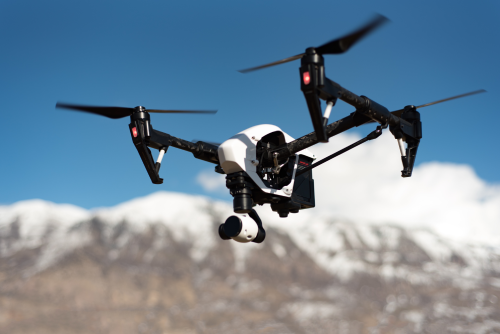
Sunset is one of the best times to fly for dramatic light, warm colours, and long shadows. But the best camera settings for drone photography at sunset are not the same as your daytime settings: light drops quickly, the sky is much brighter than the ground, and small drone sensors can lose detail fast if you expose carelessly.
Quick Take
If you want a solid starting point for drone photography at sunset, begin here:
- Shoot in RAW if your drone allows it.
- Use Manual or Pro mode for consistent results.
- Keep ISO at 100 whenever possible.
- Start with a shutter speed around 1/100 to 1/250 for still photos, depending on wind and movement.
- If your drone has adjustable aperture, stay around f/4 to f/5.6.
- Lock white balance instead of leaving it on Auto.
- Slightly protect the highlights by underexposing a little rather than blowing out the sky.
- Use the histogram and highlight warning, not just the phone screen.
- Turn on AEB (Auto Exposure Bracketing) for scenes with a bright sky and dark foreground.
- Clean the lens before takeoff. Dust, haze, and salt spray are especially visible at sunset.
Why sunset is harder than it looks from a drone
Sunset light looks beautiful to your eyes because your brain balances bright skies and dark ground instantly. Your drone camera cannot do that nearly as well, especially on entry-level drones.
At sunset, you are dealing with three challenges at once:
- High dynamic range: the sky can be very bright while buildings, trees, fields, or water are much darker.
- Rapidly changing light: good settings at 6:05 pm may be wrong by 6:12 pm.
- Atmospheric haze: common in many Indian cities and plains, especially in summer and winter, which can reduce contrast and make sunsets look washed out.
That is why good sunset photos are less about one “magic setting” and more about a small set of smart choices.
Best camera settings for drone photography at sunset
Shoot RAW first, JPEG second
If your drone supports RAW, use it.
RAW files keep more image data than JPEG, which gives you much more freedom to recover shadows, reduce highlights, and fine-tune colour later. Sunset scenes often need exactly that.
Use JPEG only if:
- your drone does not support RAW
- you need instant social media uploads
- you do not plan to edit much
For most serious sunset work, RAW is the safer choice.
Use Manual or Pro mode when possible
Auto mode can work, but it often makes poor decisions at sunset. It may brighten the ground too much and blow out the sky, or keep changing exposure from one shot to the next.
Manual or Pro mode gives you consistency, which matters when:
- you are shooting panoramas
- you want a clean silhouette
- you are making multiple frames of the same scene
- you plan to edit later
If you are still new and full manual feels stressful, a simple compromise is:
- use Auto exposure
- dial in -0.3 EV to -1.0 EV if your app allows it
- lock exposure once the sky looks right
That alone can improve beginner sunset shots a lot.
Keep ISO as low as possible
For still photography at sunset, low ISO is one of the biggest quality wins.
Start with:
- ISO 100 as your default
- ISO 200 only if needed
- avoid pushing higher unless the scene is too dark and you accept more noise
On many consumer drones, especially compact models, image noise rises quickly as ISO climbs. Noise is even more obvious in sunset shadows and gradients.
If your image looks too dark at ISO 100, do not immediately raise ISO. First ask:
- Can I slow the shutter a little?
- Can I hover more steadily?
- Can I use AEB instead of forcing one compromised shot?
- Is the light simply too low for a clean image?
Sometimes the best setting is not a higher ISO. Sometimes it is landing five minutes earlier.
Set shutter speed to balance sharpness and light
Unlike handheld cameras, drones use a gimbal to stabilize the camera, which helps. But the drone itself is still moving slightly in the air, especially in evening wind.
A good starting range for still photos is:
- 1/100 to 1/160 for calm conditions and wide landscapes
- 1/200 to 1/320 if there is more wind or your subject has movement
- 1/60 to 1/80 only when the drone is very stable and you are careful
Why not always go slower? Because even small movement can soften the image. At sunset, many photos look “not quite sharp” because the shutter got too slow.
A practical rule: – if the drone is hovering steadily and the scene is static, you can take some risk – if there is wind, water texture, traffic, or birds, use a faster shutter
Choose the right aperture if your drone allows it
Many drones have a fixed aperture, so you may not need to think about this at all. But if your drone has adjustable aperture, avoid the assumption that “smaller aperture is always better.”
For sunset drone photos, a useful range is usually:
- f/4 to f/5.6 for sharpness and control
- use wider apertures if light is dropping fast
- avoid very small apertures such as f/8 or beyond on small sensors unless you truly need them
Small drone sensors can lose detail from diffraction at narrow apertures. In plain terms, stopping down too much can make the image softer instead of sharper.
If your drone has a fixed aperture, then your main tools are simply:
- ISO
- shutter speed
- exposure control
- white balance
- RAW capture
Lock white balance
This is one of the most overlooked sunset settings.
If white balance stays on Auto, your drone may cool down one frame, warm up the next, and give you inconsistent colours across a series. That is especially bad for panoramas and edited sets.
For sunset photography, try:
- Daylight or Cloudy preset
- or a manual white balance around 5600K to 6500K
Use the lower end if:
- the scene already looks very orange or red
- there is heavy haze or dust
- the colours are becoming muddy
Use the higher end if:
- the sunset feels too pale
- you want to preserve warm golden tones
Do not chase exact numbers too much. The main goal is consistency.
Expose for the sky first
At sunset, the sky is often the star of the image. If you blow it out, you usually cannot recover the best part of the scene.
That means:
- protect highlights
- let shadows go slightly dark if needed
- recover foreground detail later from RAW if possible
A beginner mistake is trying to make everything bright in-camera. That usually creates a flat foreground and a washed-out sky.
A better approach is:
- Frame the shot.
- Watch the sky near the sun, but not the sun disc itself.
- Reduce exposure until cloud detail and colour look natural.
- Check whether the ground is usable.
- If the ground is too dark, use AEB rather than overexposing the whole scene.
For silhouettes, go even darker. A strong silhouette often looks better than a badly lifted foreground.
Use the histogram and highlight warning
Your phone screen can be misleading in bright outdoor conditions. A sunset may look perfect on-screen and still be overexposed.
Use tools such as:
- histogram
- zebras
- highlight warning
A simple reading of the histogram:
- if it is hard pushed to the right, highlights may be clipping
- if it is heavily pushed left, shadows may be very dark
- a sunset image does not need a “perfect middle” histogram
What matters is keeping useful detail in the bright sky while deciding how much shadow you are willing to accept.
Focus once and confirm sharpness
Many drones use fixed focus, but many also offer tap-to-focus or autofocus.
Before you start shooting:
- tap to focus on a distant subject such as a building edge, tree line, or horizon area
- zoom in on the preview if your app allows it
- confirm details look crisp
If your drone allows focus lock, use it once focus is correct. This prevents the camera from hunting as you recompose.
If you change altitude or subject distance significantly, check focus again.
Turn on AEB for difficult scenes
AEB means Auto Exposure Bracketing. The drone takes multiple photos at different exposures, usually 3 or 5 frames.
Use AEB when:
- the sky is bright and the ground is dark
- you are shooting city skylines
- there are clouds with strong highlights
- you want maximum flexibility in editing
AEB is often more useful at sunset than aggressive HDR modes because it gives you cleaner files and more natural control later.
For beginners, it is one of the safest sunset features to use.
Recommended sunset settings by scene
These are starting points, not rigid rules. Adjust based on your drone, wind, and light.
| Scene | Good starting settings | Why it works |
|---|---|---|
| Silhouette against sunset sky | RAW, ISO 100, 1/250 to 1/500, WB 6000K to 6500K | Keeps the sky rich and subject dark for a clean silhouette |
| Landscape with foreground detail | RAW, ISO 100, 1/100 to 1/200, WB 5800K to 6500K, AEB on | Protects sky while giving you recoverable shadows |
| Water, beach, or lake reflections | RAW, ISO 100, 1/80 to 1/160, WB 5600K to 6200K | Holds colour in the sky and soft texture in the water |
| City skyline near sunset | RAW, ISO 100 to 200, 1/100 to 1/200, AEB on, WB locked | Helps control bright sky and darker buildings |
| Panorama at sunset | RAW, ISO 100, lock exposure and WB, 1/125 or faster | Prevents colour and exposure mismatch between frames |
| Hazy urban sunset | RAW, ISO 100, slight underexposure, WB around 5600K to 6000K | Stops the scene from turning overly orange and flat |
A simple sunset shooting workflow that works on most drones
1. Arrive early and set up before the colour starts
Try to be ready before the best light begins. Sunset is short, and you do not want to spend those minutes changing settings or searching for a safe takeoff point.
Look for:
- open takeoff space
- wind direction
- obstacles such as wires, cranes, and towers
- birds, especially near water or trees
2. Clean the lens and set the camera before takeoff
This matters more than many beginners expect.
Set:
- RAW
- ISO 100
- manual or Pro mode
- white balance locked
- histogram on
- AEB ready if needed
A tiny smudge on the lens can create flare and soft contrast, especially when shooting toward the sun.
3. Start with wider compositions
In the earlier phase of sunset, shoot:
- broad landscapes
- long shadow patterns
- river bends
- coastlines
- fields, roads, rooftops, or hill lines
This is when the ground still has enough light to support detail.
4. As the sun drops, simplify the frame
Later in the sunset, cleaner compositions often work better:
- silhouettes
- a single building or temple outline
- a boat on water
- a lone tree
- a road cutting through golden light
Complex scenes get messy quickly when shadows deepen.
5. Re-check exposure every few minutes
Sunset changes fast. What worked a few minutes earlier may now be too bright or too dark.
Keep checking:
- histogram
- highlight clipping
- shutter speed
- whether ISO has changed accidentally
6. Take bracketed shots before the light disappears
If a scene looks special, do not rely on one frame. Capture:
- one normal exposure
- one AEB sequence
- one slightly darker version for safety
This gives you options when editing later.
7. Land with a comfortable margin
Do not chase the last bit of colour with a low battery and poor visibility. Evening wind can be stronger at altitude, and orientation can become harder as light falls.
If you are also recording video at sunset
This article is focused on photography, but many drone users shoot both. If you also want sunset video, keep these points in mind:
- Lock white balance.
- Keep ISO as low as possible.
- Use the 180-degree rule as a starting point: for 25 fps, use about 1/50 shutter; for 30 fps, about 1/60.
- Use an ND filter only while the light is still bright enough to need it.
- As the sun drops, remove heavy ND filters or your footage may become too dark.
- Use a flatter colour profile only if you know how to grade it later.
For complete beginners, a normal colour profile with careful exposure often gives better results than flat video that is never properly edited.
Safety, legal, and compliance checks in India
Sunset flights can be beautiful, but they also come with extra risk.
Keep these points in mind:
- Verify the latest official Indian rules before flying. Airspace permissions, operational limits, and local restrictions can change.
- Check the latest guidance from the DGCA, Digital Sky, and any local authority requirements relevant to your location.
- Do not assume that flying close to night, in low visibility, or after sunset is automatically allowed.
- Stay well clear of airports, helipads, military areas, government-sensitive zones, and other restricted locations.
- Avoid flying over crowds, busy roads, festivals, beaches packed with people, or wedding gatherings unless all permissions and safety controls are clearly in place.
- Maintain visual line of sight.
- Be extra careful near lakes, wetlands, coastlines, and fields where birds may become more active around dusk.
- Respect privacy. A sunset over a neighbourhood is not permission to film into homes or terraces.
A good sunset shoot is not worth a risky launch, a lost drone, or a rule violation.
Common mistakes at sunset
Leaving white balance on Auto
This causes inconsistent colours and makes editing harder.
Trusting the screen more than the histogram
Phone displays can fool you, especially outdoors.
Raising ISO too quickly
Noise in shadows is one of the biggest quality killers in sunset drone photos.
Trying to brighten the foreground too much in-camera
This often ruins the sky. Protect the highlights first.
Using too slow a shutter in wind
The shot may look fine on the small preview, then look soft later on a bigger screen.
Forgetting AEB
One bracketed sequence can save a difficult scene.
Keeping an ND filter on when light falls
ND filters help in brighter conditions, but later in sunset they can force unnecessarily slow shutter speeds for photos.
Shooting only straight into the sun
Some of the best sunset drone photos are 45 to 90 degrees away from the sun, where side light creates depth and long shadows.
Not planning for haze
In many Indian locations, especially urban and industrial areas, haze can flatten colour. A slightly different angle, higher altitude, or earlier timing can improve the shot.
FAQ
Should I use Auto mode or Manual mode for sunset drone photos?
Manual or Pro mode is usually better because it keeps exposure consistent. If you are a beginner, Auto mode with slight negative EV and exposure lock is a decent starting point.
What is the best ISO for drone photography at sunset?
ISO 100 is the best starting point. Use ISO 200 only if needed. Higher ISO can quickly add noise, especially on smaller drone sensors.
What shutter speed is best for sunset still photos?
For most scenes, start around 1/100 to 1/250. Go faster in wind or when the subject is moving. Go slower only if the drone is very stable and you are confident the shot will stay sharp.
Should I shoot RAW or JPEG at sunset?
RAW is strongly recommended because sunset scenes often need highlight recovery and shadow adjustment. JPEG is fine only for quick sharing or if your drone does not support RAW.
What white balance should I use at sunset?
Lock it instead of using Auto. A good starting range is 5600K to 6500K, or use Daylight/Cloudy presets. Adjust based on how warm or hazy the scene looks.
Do I need an ND filter for sunset photos?
Usually not in the later part of sunset for still photography. ND filters are more useful when the light is still strong or when shooting video. If your shutter becomes too slow, remove the ND filter.
How do I capture both the bright sky and the dark ground?
Use AEB or bracketed shots, expose for the sky, and recover the foreground in editing. Trying to make both perfect in one aggressive exposure often leads to poor results.
Why do my sunset drone photos look soft?
Common reasons include dirty lens glass, slow shutter speed, wind, missed focus, too much noise reduction, or using a very small aperture on a drone with an adjustable lens.
Can I fly my drone after sunset in India?
Do not assume you can. Verify the latest official DGCA and Digital Sky guidance, along with any local restrictions and permissions. The safest approach is to plan your main shoot well within clear legal and visual operating conditions.
Final takeaway
If you want better sunset drone photos, do not overcomplicate it: shoot RAW, keep ISO low, lock white balance, protect the sky, and use AEB when contrast is high. On your next flight, set up early, clean the lens, start at ISO 100 with a locked WB, and watch the histogram instead of trusting the screen alone.
