Introduction
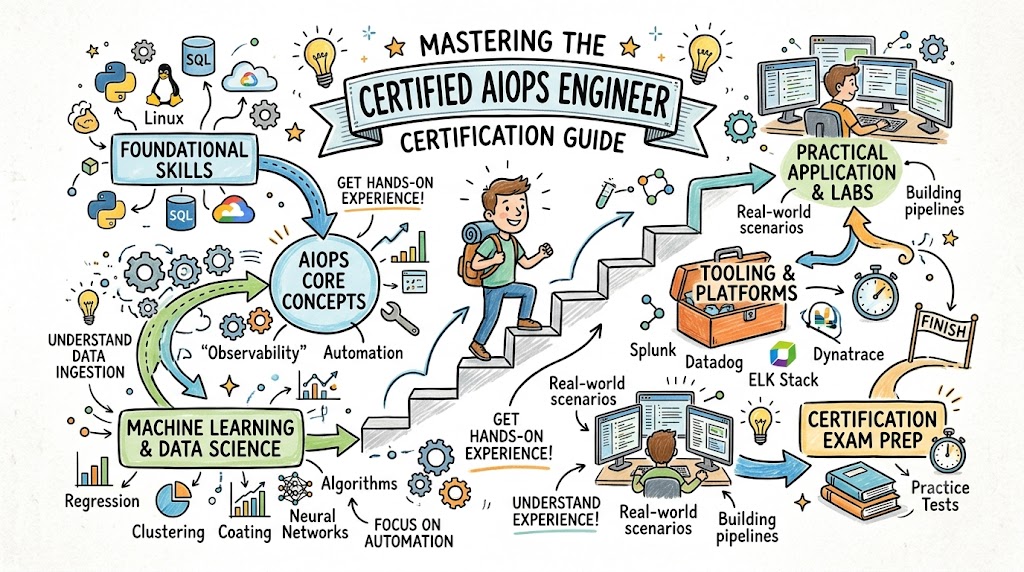
Modern enterprise infrastructure generates massive volumes of telemetry data that traditional monitoring tools can no longer handle efficiently. The Certified AIOps Engineer program bridges the gap between artificial intelligence and infrastructure operations. This comprehensive guide is designed for systems engineers, site reliability experts, and technology leaders who need to transition from reactive monitoring to proactive, AI-driven operations. By exploring this structured learning path, professionals can make informed career decisions and acquire the competencies required to manage complex, self-healing cloud architectures. This program, hosted on aiopsschool, provides the precise framework needed to validate expertise in modern operational intelligence.
What is the Certified AIOps Engineer?
The Certified AIOps Engineer designation represents a professional standard for engineering teams aiming to deploy machine learning models within operational pipelines. It exists to formalize the skills required to aggregate logs, metrics, and traces, and then apply algorithmic analysis to automate anomaly detection. Unlike purely theoretical data science courses, this curriculum focuses heavily on production-grade infrastructure and automated incident remediation workflows. By aligning directly with modern enterprise environments, the program ensures that engineers can directly apply algorithmic insights to reduce mean time to resolution in live environments.
Who Should Pursue Certified AIOps Engineer?
This certification specifically benefits Site Reliability Engineers (SREs), cloud architects, and systems administrators who manage high-availability infrastructure. Technical managers and enterprise platform leaders will also find value in this curriculum to better architect automated governance and intelligent scaling strategies. Globally, businesses are rapidly integrating algorithmic operations to minimize downtime, making this credential highly relevant across international tech hubs. In India, where enterprise cloud migrations and global capability centers are expanding exponentially, holding this validation positions infrastructure professionals for rapid career progression.
Why Certified AIOps Engineer
The modern enterprise tech stack has grown too complex for manual human oversight, resulting in an unprecedented demand for automated operational intelligence. Achieving this certification ensures that your skills remain relevant even as specific underlying cloud providers or infrastructure tools change over time. It shifts an engineer’s value proposition from basic script writing to designing self-healing, intelligent platforms that directly impact business uptime. The return on investment is realized through accelerated incident response capabilities, lower operational overhead, and a clear competitive advantage in the senior engineering market.
Certified AIOps Engineer Certification Overview
The structured educational program is delivered via the official training portal and is hosted entirely on the aiopsschool platform. The program evaluates candidates through a combination of rigorous performance-based practical examinations and core conceptual assessments. Ownership of this credential demonstrates a verifiable mastery of multi-source data ingestion, algorithmic anomaly detection, and automated incident response workflows. The curriculum is maintained by industry experts to reflect the actual operational challenges encountered within enterprise-scale cloud architectures.
Certified AIOps Engineer Certification Tracks & Levels
The certification framework is divided into distinct operational tiers, starting with foundational concepts and progressing to advanced system architecture. The initial levels focus on data ingestion pipelines, standard metrics visualization, and basic statistical thresholding techniques. The professional and advanced levels introduce deep learning models, natural language processing for log analysis, and root-cause analysis automation. These tracks allow engineers to align their certification journey precisely with their current day-to-day responsibilities and long-term career aspirations.
Complete Certified AIOps Engineer Certification Table
| Track | Level | Who it’s for | Prerequisites | Skills Covered | Recommended Order |
|---|---|---|---|---|---|
| Operations Foundation | Associate | Junior Systems Engineers | Basic Linux & Networking | Data Ingestion, Basic Telemetry, Dashboarding | First |
| Algorithmic SRE | Professional | Mid-Level SREs & DevOps | Python, PromQL, Cloud Basics | Anomaly Detection, Event Correlation | Second |
| Enterprise Architecture | Advanced | Principal Engineers & Leads | Machine Learning Pipelines | Root Cause Analysis, Automated Remediation | Third |
Detailed Guide for Each Certified AIOps Engineer Certification
Certified AIOps Engineer – Associate Level
What it is
This entry-tier validation confirms an engineer’s capability to configure baseline operational pipelines and aggregate multi-source telemetry data. It proves that the candidate understands how to normalize logs and metrics before applying analytical models.
Who should take it
This course is intended for junior DevOps engineers, systems administrators, and recent technical graduates. It serves those looking to build a structured baseline in data-driven infrastructure management.
Skills you’ll gain
- Configuration of open-source data collectors and log forwarders.
- Construction of unified monitoring dashboards for heterogeneous environments.
- Implementation of basic statistical thresholding for alerting systems.
Real-world projects you should be able to do
- Deploy an enterprise-wide telemetry collection layer across a multi-region cloud cluster.
- Build a centralized visualization dashboard that consolidates metrics from databases, microservices, and networks.
Preparation plan
- 7-14 Days: Focus on the core mechanics of data ingestion tools, parsing configurations, and standard logging formats.
- 30 Days: Build active labs combining various data sources into a single monitoring system and practice writing queries.
- 60 Days: Take practice examinations, review documentation anomalies, and optimize index performance across sample datasets.
Common mistakes
- Spending too much time on complex machine learning math while neglecting basic data parsing and cleaning techniques.
- Failing to understand the specific performance impact of high-cardinality metadata on storage engines.
Best next certification after this
- Same-track option: Certified AIOps Engineer – Professional Level
- Cross-track option: Cloud Infrastructure Specialist
- Leadership option: Systems Operations Lead
Certified AIOps Engineer – Professional Level
What it is
This intermediate credential validates an engineer’s ability to apply machine learning algorithms directly to operational data streams. It ensures proficiency in identifying pattern shifts, correlating alerts, and reducing alert fatigue within noisy enterprise environments.
Who should take it
Designed for mid-level Site Reliability Engineers, platform specialists, and incident managers. Candidates should possess a working knowledge of programmatic scripting and automated infrastructure deployment.
Skills you’ll gain
- Deployment of unsupervised machine learning models for real-time anomaly detection.
- Implementation of advanced event correlation engines to suppress duplicate operational alerts.
- Creation of automated pattern recognition scripts for unstructured log documentation.
Real-world projects you should be able to do
- Build an automated alert-deduplication engine that cuts operational noise by over fifty percent across production microservices.
- Design a predictive scaling policy for dynamic infrastructure based on historical traffic patterns rather than fixed thresholds.
Preparation plan
- 7-14 Days: Review time-series analysis concepts, statistical distributions, and basic clustering algorithms used in infrastructure.
- 30 Days: Set up practical sandboxes featuring simulated failure injections to test how specific algorithms respond to anomalies.
- 60 Days: Focus on optimizing model accuracy, eliminating false positives, and executing comprehensive mock exam scenarios.
Common mistakes
- Relying entirely on out-of-the-box model settings without tuning parameters to fit specific infrastructure behaviors.
- Overlooking the network latency introduced when routing massive telemetry data to external analytical engines.
Best next certification after this
- Same-track option: Certified AIOps Engineer – Advanced Level
- Cross-track option: Enterprise DevSecOps Architect
- Leadership option: Technical Program Manager – Infrastructure
Certified AIOps Engineer – Advanced Level
What it is
This tier confirms mastery in building fully autonomous, self-healing enterprise platforms using advanced cognitive systems. It proves an architect’s capability to orchestrate closed-loop remediation workflows without relying on manual intervention.
Who should take it
Principal engineers, infrastructure architects, and technical directors responsible for global system reliability and operational strategy.
Skills you’ll gain
- Architectural design of end-to-end autonomous remediation frameworks.
- Integration of natural language processing for automated incident post-mortem generation.
- Governance and lifecycle management of machine learning models within operational pipelines.
Real-world projects you should be able to do
- Construct a closed-loop remediation system that detects, isolates, and resolves database performance bottlenecks automatically.
- Architect a distributed root-cause analysis engine that maps dependencies across thousands of ephemeral microservices.
Preparation plan
- 7-14 Days: Study advanced system architectures, distributed consensus models, and the lifecycle management of operational machine learning models.
- 30 Days: Develop complex, multi-tiered failure scenarios in a staging laboratory and build scripts capable of autonomous healing.
- 60 Days: Validate system design choices against stringent architectural frameworks and complete expert-level peer evaluation simulations.
Common mistakes
- Designing overly complex automation scripts that accidentally create destructive feedback loops during major system outages.
- Failing to build adequate manual overrides and safety switches within the autonomous infrastructure framework.
Best next certification after this
- Same-track option: Principal Cognitive Operations Fellow
- Cross-track option: Enterprise Enterprise Architect
- Leadership option: Chief Technology Officer / VP of Infrastructure
Choose Your Learning Path
DevOps Path
This pathway focuses heavily on integrating algorithmic testing and predictive deployment verification into the continuous delivery pipeline. Engineers learn to analyze telemetry from code check-ins to production deployments automatically. The primary goal is utilizing operational intelligence to catch deployment anomalies before they impact end users. This path is ideal for professionals looking to enhance automated pipeline governance.
DevSecOps Path
This special track infuses operational intelligence directly into security monitoring and vulnerability management workflows. Professionals learn to apply behavioral anomaly detection to network logs and access patterns to identify security breaches instantly. By automating the identification of abnormal user behaviors, compliance and threat response are accelerated significantly. It provides a robust framework for managing security threats at cloud scale.
SRE Path
The Site Reliability Engineering track prioritizes minimizing the mean time to detect and resolve infrastructure incidents. Focus is placed on automatic root-cause derivation, alert noise elimination, and managing service level objectives dynamically. Engineers learn to build automated playbooks that execute safely whenever performance thresholds are crossed. This track ensures maximum uptime for critical distributed systems.
AIOps Path
This dedicated operational path focuses entirely on optimizing the data pipelines and machine learning infrastructure that power algorithmic operations. Engineers dive deeply into telemetry data streaming, high-throughput message brokers, and time-series database optimizations. It ensures that the underlying system supporting the operational models remains highly performant and reliable. This path is essential for scaling intelligence across massive architectures.
MLOps Path
This distinct framework addresses the challenges of deploying, versioning, and monitoring machine learning models within production environments. It teaches engineers how to manage model drift, automate retraining pipelines, and ensure data lineage compliance. By bridging the gap between data science teams and cloud operations, it stabilizes enterprise intelligence applications. It is tailored for engineers managing heavy machine learning workloads.
DataOps Path
This curriculum specializes in maintaining the health, quality, and reliability of complex, enterprise-wide data delivery pipelines. Professionals learn to monitor database performance, automate ETL pipeline recovery, and detect anomalies in data streams. It treats data delivery as an engineering discipline, ensuring downstream analytical applications receive clean information. This is ideal for infrastructure engineers supporting massive data platforms.
FinOps Path
This specialized track combines financial accountability with intelligent cloud provisioning algorithms to maximize cloud spend efficiency. Engineers learn to predict resource utilization trends and automate the termination or resizing of underutilized assets. By utilizing predictive analytics, organizations can avoid surprise cloud invoices and optimize their overall infrastructure investments. It provides a direct path toward automated, data-driven cloud cost optimization.
Role → Recommended Certified AIOps Engineer Certifications
| Role | Recommended Certifications |
|---|---|
| DevOps Engineer | Associate Level Foundation, Continuous Delivery Specialist |
| SRE | Professional Level Algorithmic SRE, Incident Automation Specialist |
| Platform Engineer | Advanced Level Architecture, Distributed System Specialist |
| Cloud Engineer | Associate Level Foundation, Multi-Cloud Management Track |
| Security Engineer | Security Analytics Specialization, Log Anomaly Track |
| Data Engineer | DataOps Specialization, Pipeline Reliability Track |
| FinOps Practitioner | Predictive Cost Management Track, Cloud Optimization Specialist |
| Engineering Manager | Operational Governance Path, Advanced Level Architecture |
Next Certifications to Take After Certified AIOps Engineer
Same Track Progression
Upon completing the core levels, engineers should pursue deep architectural specializations focusing on specific domain models. This involves exploring specialized certifications centered around advanced neural networks designed exclusively for time-series telemetry data. Moving vertically through this track cements your authority as a subject matter expert in self-healing system design. It ensures your long-term capability to lead complex digital transformation initiatives within large enterprise environments.
Cross-Track Expansion
Broadening your technical footprint requires pursuing credentials in complementary spaces like advanced cloud-native architecture or large-scale data engineering. Acquiring deep expertise in container orchestration platforms or distributed streaming frameworks provides a solid foundation for algorithmic tools. This horizontal skill development enables engineers to understand the deep underlying mechanics of systems they are automating. It builds a versatile profile highly attractive to cross-functional enterprise platform engineering teams.
Leadership & Management Track
For professionals transitioning away from purely hands-on engineering, the logical next step involves focusing on strategic governance frameworks. Certifications in enterprise IT strategy, financial operations governance, and technical team leadership help bridge the gap between automation and business value. This educational progression prepares senior engineers to manage large operational budgets and lead global engineering organizations. It transforms technical proficiency into high-impact executive leadership capability.
Training & Certification Support Providers for Certified AIOps Engineer
DevOpsSchool provides comprehensive classroom training and tailored bootcamp programs focusing heavily on production-level hands-on laboratory exercises.
Cotocus offers specialized training solutions designed for corporate teams looking to upskill their engineering staff in automated infrastructure workflows quickly.
Scmgalaxy serves as a deep repository of technical tutorials, study guides, and community forums supporting engineers throughout their certification journeys.
BestDevOps focuses on delivering highly practical instructional courses that teach the core realities of running continuous delivery pipelines efficiently.
devsecopsschool delivers deeply specialized educational paths aimed at blending automated security checking tools seamlessly into standard engineering pipelines.
sreschool provides targeted learning curriculums focusing entirely on site reliability engineering principles, modern error budgeting, and advanced incident response.
aiopsschool offers the foundational learning modules, official examination practice sets, and formal certification validation paths for algorithmic operations.
dataopsschool addresses the growing demand for structured training in managing, monitoring, and scaling complex corporate data delivery pipelines.
finopsschool delivers clear, experience-driven training focused on cloud cost optimization, automated resource management, and corporate financial governance.
Frequently Asked Questions (General)
- What is the primary benefit of achieving an operational intelligence credential?
It validates your specialized ability to manage complex, modern infrastructure by using machine learning to automate standard incident response workflows. - How long does it typically take to prepare for the professional level examination?
Most candidates dedicating consistent study time require between thirty to sixty days to thoroughly master the curriculum and laboratory exercises. - Are there strict coding prerequisites required before attempting the baseline certification?
A basic familiarity with programmatic scripting languages like Python and shell scripting is highly recommended for navigating the laboratory challenges. - Does this certification focus on a single specific cloud vendor platform?
No, the core curriculum teaches vendor-neutral principles and open-source tools that can be applied across any public or private cloud environment. - How does this program help in reducing operational alert fatigue within teams?
It provides practical blueprints for building event correlation engines that group duplicate alerts and filter out normal system background noise. - What is the format of the official evaluation assessment?
The evaluation consists of multiple-choice conceptual questions combined with hands-on, performance-based scenario troubleshooting inside a live laboratory environment. - Can an engineering manager benefit from completing the foundational levels?
Yes, it equips management professionals with the exact technical vocabulary and architectural awareness needed to lead modern platform engineering teams. - How often are the certification curriculum and exam questions updated?
The program materials are reviewed regularly to incorporate the latest enterprise tooling updates and shifting production infrastructure methodologies. - What is the career outlook for professionals holding advanced operational credentials?
Demand remains exceptionally high as enterprises globally look to lower operational costs and replace manual incident management with intelligent automation. - Is classroom training mandatory, or can I self-study for the examination?
While self-study paths are fully supported via official documentation, structured bootcamps significantly accelerate preparation through guided access to lab environments. - Does the exam test theoretical machine learning mathematics extensively?
The evaluation focuses primarily on the practical deployment, configuration, and monitoring of models rather than deep statistical theorem proofs. - What distinction sets this curriculum apart from standard data science certifications?
This program is built specifically for operational engineers, prioritizing live systems uptime, logging frameworks, and infrastructure health over general business analytics.
FAQs on Certified AIOps Engineer
- What specific machine learning algorithms are covered in the Certified AIOps Engineer course? The curriculum focuses extensively on time-series anomaly detection algorithms, clustering methods for log grouping, and supervised classification models for alert routing. Students learn how to apply these models directly to live streams of operational telemetry. The course avoids abstract mathematical theory, focusing instead on practical parameter tuning and model deployment inside active infrastructure pipelines.
- How does the Certified AIOps Engineer course address multi-cloud infrastructure environments? The training is designed from the ground up to be entirely cloud-agnostic, focusing heavily on open-source data collectors and standardized ingestion APIs. This ensures that the analytical strategies learned can be deployed seamlessly across AWS, Azure, Google Cloud, or on-premises enterprise data centers. It teaches engineers how to normalize disparate cloud telemetry formats into a singular cohesive data plane.
- Can I pass the Certified AIOps Engineer exam without any prior Python programming experience? While a master-level software engineering background is not mandatory, having a basic working knowledge of Python syntax is highly beneficial for the professional and advanced tiers. The practical lab exams require candidates to read, modify, and deploy configuration scripts that interface directly with analytical APIs. Complete beginners should review foundational scripting principles before attempting the advanced practical labs.
- What type of practical laboratory environments are provided during the Certified AIOps Engineer training? Candidates receive access to live, simulated enterprise infrastructure clusters designed to mimic production scale and failure modes. These sandboxes generate synthetic traffic, random performance degradation, and complex multi-service outages. Students must actively configure data pipelines and deployment models to successfully identify and resolve these injected operational issues in real time.
- How does the Certified AIOps Engineer credential directly impact an engineer’s daily SRE responsibilities? It changes day-to-day operations from a continuous cycle of manual log searching to managing automated, proactive platforms. Holding this credential indicates that an engineer can build automated filtering engines that eliminate redundant system notifications. This significantly decreases the frequency of manual late-night engineering pages while protecting corporate service level objectives.
- What is the retake policy if a candidate fails the Certified AIOps Engineer assessment? If you do not pass the examination on your first attempt, a standard cooling-off period is required before registering for a re-examination. This buffer time allows candidates to revisit the core learning modules, access the sandbox labs, and address specific weak areas identified in the exam summary report. Detailed retake window timelines are managed through the main dashboard.
- How does the Certified AIOps Engineer program handle the challenge of model drift in production? The advanced levels of the program feature dedicated modules covering data drifting and continuous model retraining strategies within infrastructure monitoring pipelines. Engineers are taught how to monitor the accuracy of their anomaly detection systems over long operational periods. This ensures that natural infrastructure growth does not result in a high volume of false alerts.
- Are there any group or corporate enterprise discount programs available for this certification? Yes, customized group onboarding options are supported for enterprises seeking to standardize operational practices across entire engineering segments. These corporate packages frequently bundle official examination access tokens with guided training sessions and dedicated sandbox laboratory environments. Enterprise training procurement teams can arrange these customized programs directly through the primary administration portal.
Final Thoughts: Is Certified AIOps Engineer Worth It?
Investing time and effort into obtaining professional credentials should always map back to real-world career advancement and enhanced operational stability. The shift toward algorithmic operations is not a passing phase; it is an absolute technical necessity driven by the scale of modern cloud-native systems. This program provides engineers with a highly structured, practical, and verified path to transition away from stressful, reactive firefighting toward high-value, intelligent platform design. If your goal is to lead infrastructure automation and command a senior position in the modern engineering marketplace, acquiring this validation is a sound professional decision.
