Introduction
Have you ever wondered how massive manufacturing plants keep track of hundreds of working machines without losing count? Handling clever hardware takes careful planning, steady routines, and the right digital tools. This article explores how teams look after daily machine tasks, update computer programs, and make sure every helper runs safely. You will learn how modern systems like ROS 2 and virtual testing labs help workers control their equipment. By the end, you will see how straightforward software ideas keep big mechanical helpers running smoothly every single day.
What Is RobotOps and Why Do We Need It?
Think of a modern robot as a small computer built onto wheels or attached to a heavy metal arm. Just like your smartphone needs regular software updates and battery care, these mechanical workers need attention too. RobotOps is simply a collection of rules and habits for looking after robot software. It helps engineering teams build, test, and fix machines while they operate out in the real world.
Without proper care, machines can stall or make costly mistakes. When teams use structured Robotics Operations, they can catch errors quickly. They do not have to guess what went wrong because they can view live performance data right on their monitors. This keeps workspaces safe and saves valuable hours.
How Teams Handle Robot Fleet Management
When a warehouse owns more than one machine, things get busy very fast. Robot Fleet Management is the underlying system that tells each unit where to drive so they never bump into one another. It works much like an automated air traffic control tower, but for wheels rolling across a concrete floor.
Key Tasks in Fleet Management
- Checking battery levels so machines never run out of juice mid-task.
- Planning safe driving paths around stacked boxes and walking workers.
- Sending software updates to dozens of units at the exact same moment.
- Tracking how many completed tasks each helper finishes every hour.
Powering Smart Factories With Industrial Robotics
Most people picture giant steel arms welding car doors together on an assembly line. That is the core world of Industrial Robotics. These heavy-duty workers handle tough, dangerous jobs that would be risky for human staff.
They use specialized sensors to figure out where parts are resting. They move with exact precision on every single cycle. To perform well, they rely heavily on robust Robotics Software that tells their motors how fast to turn and their sensors when to check the surroundings.
| Machine Category | Primary Duty | Common Location |
| Robotic Arm | Welding and lifting heavy car components | Manufacturing plants |
| Mobile Base | Carrying parts from shelf to packing stations | Large fulfillment hubs |
| Cleaning Unit | Scrubbing and sweeping wide floors | Commercial buildings |
Testing Safely With Robot Simulation
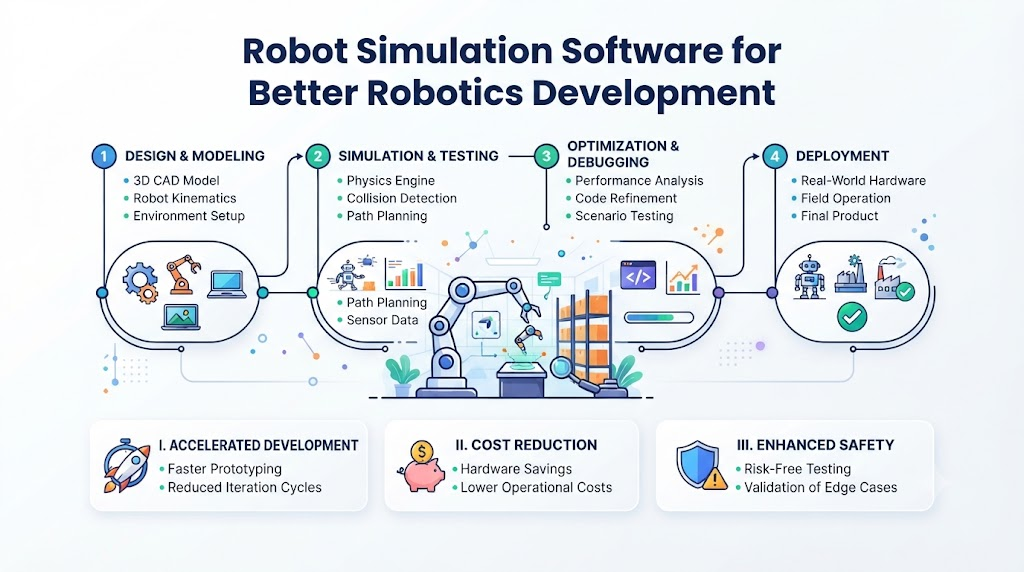
Before any new software goes onto a real machine, safety comes first. Teams use Robot Simulation to test their new code inside a computer video game world before touching physical hardware.
This digital copy lets developers check if the machine can make tight turns or spot walls safely. If the robot bumps into a virtual wall, nobody gets hurt and nothing breaks. It is a safe, smart way to try out experimental code before letting the machine loose in a busy building.
Moving Goods With Autonomous Mobile Robots
Have you ever seen small motorized carts rolling down aisleways carrying bins all by themselves? Those are Autonomous Mobile Robots. They do not need a human driver or any fixed tracks glued to the floor.
They use onboard lasers and cameras to map out their rooms. If they spot a dropped box blocking their path, they stop and drive around it. This type of Robotics Automation helps stores fulfill your online purchases much faster and with fewer errors.
Running a Central Control Room
When an organization runs a massive group of machines day and night, it needs a central spot to watch them all. A Robotics Operations Center is a room filled with computer displays where engineers watch live telemetry feeds.
Telemetry simply means the continuous stream of data sent by a machine regarding its current health, speed, and position. If a unit gets stuck, the control center spots the alert immediately and sends a human worker to help out.
The Power of ROS 2 in Modern Development
Building code for mechanical helpers used to be very difficult because every manufacturer used totally different software languages. Today, many developers rely on ROS 2, which stands for Robot Operating System 2.
It is a shared collection of software tools that lets different parts of a machine talk to one another seamlessly. A programmer can write camera code for one brand of robot and reuse it on another. This saves time and makes building clever machines much easier for everyone.
Frequently Asked Questions About RobotOps
What is RobotOps in simple terms?
It is the practice of using software tools and good habits to manage, update, and monitor robots while they do their jobs.
Why do engineers use robot simulation?
It allows developers to test new programming safely inside a virtual computer world before placing it onto a physical machine.
What does ROS 2 stand for?
It stands for Robot Operating System 2, a popular open software framework used to build robot applications.
How do autonomous mobile robots move around?
They use onboard sensors, cameras, and clever navigation software to map their environment and steer clear of obstacles.
What is robot fleet management?
It is a control system that directs a large group of machines at the same time so they can work together safely.
What does telemetry mean for a robot?
Telemetry is the ongoing stream of stats a machine sends back regarding its health, battery charge, and current status.
Where can people learn more about these concepts?
Websites like RobotsOps.com offer helpful educational articles and technical resources for students and engineers alike.
Are industrial robots the same as mobile robots?
No, industrial robots are usually fixed mechanical arms in factories, whereas mobile robots drive around to shift materials.
What is a robotics operations center?
It is a central monitoring room where teams watch live data feeds and handle warnings for all active machines.
Why is active voice important in robotics articles?
It keeps instructions concise, clear, and easy for readers of all skill levels to grasp without confusion.
Final Thoughts
Managing modern machines does not have to feel like a complex puzzle. When teams utilize clever software, clear monitoring, and safe testing environments, overseeing a fleet of mechanical helpers becomes straightforward. Educational hubs like RobotsOps.com help curious learners understand how these systems function in the real world. By grasping the basics of fleet control, smart software, and safe automation, anyone can dive into the exciting future of modern technology.
