Introduction
Unmanned aerial systems are changing how industries operate across India. Drones are no longer just hobby gadgets; they are core professional tools used extensively in modern farming for crop monitoring and spraying, aerial photography, land surveying, infrastructure mapping, and industrial inspection.
As the skies become busier, legal and safe operations depend heavily on proper pilot certification. Holding a valid certification ensures that operators understand safety protocols, airspace laws, and technical boundaries, allowing them to fly legally and professionally.
What Is DGCA Drone Pilot Certification?
The Directorate General of Civil Aviation (DGCA) is the primary national regulatory body responsible for overseeing civil aviation and civil drone operations in India. Under current aviation rules, the formal document issued to a qualified operator is called a Remote Pilot Certificate (RPC).
The Remote Pilot Certificate serves as official government recognition that an individual has completed structured training and passed mandatory assessments. It is required for anyone operating drones in weight categories where certification is legally mandated.
It is important to distinguish this certificate from other regulatory elements: a drone’s Unique Identification Number (UIN) registers the physical aircraft, a Type Certificate approves a specific drone model’s airworthiness, and a training course completion document is merely proof of attending a school. An RPC is specifically the pilot’s legal permit to fly.
Who Can Apply for Drone Pilot Certification?
Entering the drone training ecosystem requires meeting a few baseline standards established by regulatory guidelines.
- Age: Applicants generally must be at least 18 years old.
- Education: Candidates typically need a minimum qualification of passing Class 10 (matriculation) from a recognized board.
- Language: Basic proficiency in reading, understanding, and communicating in English is required to interpret manuals and airspace instructions.
- Identity: Valid government-issued identity and address verification documents must be provided.
Because admission workflows can vary slightly, candidates should always verify exact intake rules and document checklists directly with their chosen DGCA-authorised Remote Pilot Training Organisation (RPTO) rather than assuming a single standard applies universally.
Types and Categories of Drone Pilot Certification
Certification endorsements correspond to specific aircraft classifications and weight thresholds. The regulatory framework recognizes major aircraft design categories such as aeroplanes, rotorcraft, and hybrid drones.
Furthermore, drones are classified by weight:
- Nano: Up to 250 grams
- Micro: Greater than 250 grams and up to 2 kg
- Small: Greater than 2 kg and up to 25 kg
- Medium and Large: Heavier commercial and industrial tiers
A pilot’s certificate carries specific endorsements that restrict operations to authorized weight classes and aircraft types. Operating outside these endorsed boundaries or confusing physical weight brackets with aircraft design types is a regulatory violation.
Step-by-Step Drone Pilot Certification Process
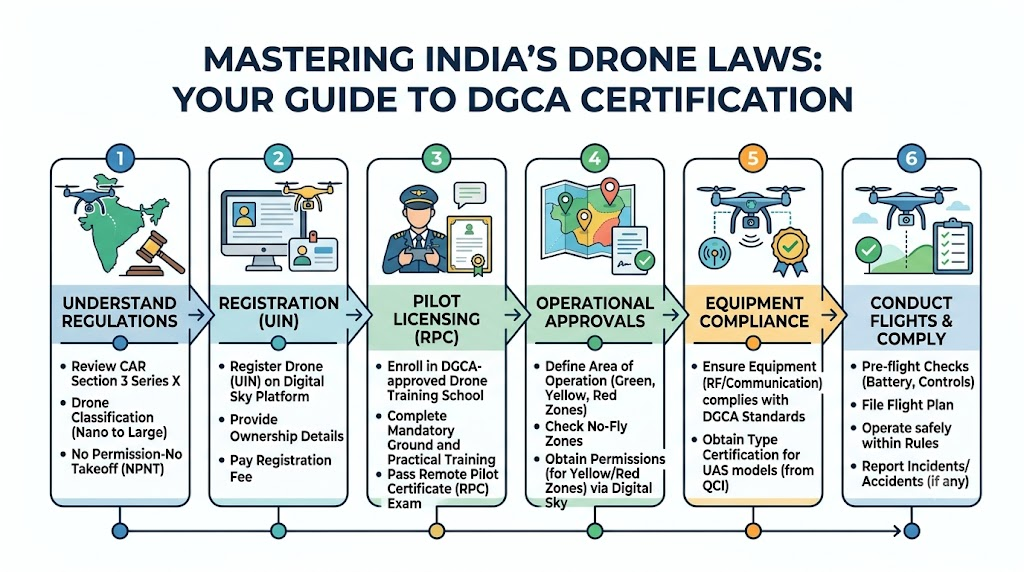
Obtaining a Remote Pilot Certificate follows a structured pathway.
| Step | Action | Description |
| 1 | Check Eligibility | Confirm that you meet the age, educational, and identification criteria. |
| 2 | Choose an Authorised RPTO | Select a DGCA-authorised Remote Pilot Training Organisation certified for your desired drone category. |
| 3 | Submit Documentation | Provide required identification, educational records, and medical declarations to the training school. |
| 4 | Complete Training | Attend ground school classes, simulator practice, and hands-on flight hours. |
| 5 | Pass Assessments | Clear the required theory examinations and practical flight skill tests. |
| 6 | Receive Certificate | Obtain your digital Remote Pilot Certificate through official government portals. |
Documents Required for Drone Pilot Training
Enrolling in a drone training program requires standard verification paperwork. While exact requirements can differ slightly among training providers, candidates commonly need:
- Proof of age (such as a birth certificate or school leaving certificate)
- Educational qualification certificate (Class 10 mark sheet or pass certificate)
- Valid government-issued identity proof (such as an Aadhaar card or voter ID)
- Passport-size photographs
- Medical fitness declarations or certificates where mandated by the course structure
Applicants should always confirm the active document checklist with their training institute prior to enrollment, as identity proof policies can occasionally accept multiple official documents.
Training Duration, Fees, and Exams
Training curricula are designed to build complete operational competency. Students study fundamental drone rules, airspace structures, weather meteorology, pre-flight inspection checklists, flight controls, emergency handling, and practical flying maneuvers.
Assessments evaluate both theoretical knowledge and practical flight handling. Because course durations and fee structures vary widely depending on the training provider, geographic location, infrastructure, and specific aircraft weight categories, students should consult individual RPTOs for precise financial and schedule details.
How to Choose a DGCA-Authorised Drone Training Organisation
Selecting the right training partner is vital for a smooth certification journey. Prospective students should carefully evaluate potential schools using several criteria:
- Authorisation Status: Verify that the institute holds an active, official DGCA authorisation listed on the official DigitalSky platform.
- Training Scope: Ensure the school is authorized to train pilots for your specific drone category.
- Faculty and Infrastructure: Look at instructor credentials, simulator quality, and the condition of the practical flying field.
- Comprehensive Support: Check whether the curriculum thoroughly covers safety practices, exam preparation, and portal documentation assistance.
Do not choose a training provider based solely on the lowest fee. Quality of instruction, safety standards, and proper regulatory authorisation matter most for long-term professional success.
Rules Drone Pilots Should Know
Earning a Remote Pilot Certificate does not exempt a pilot from daily operational regulations. Certified pilots must practice responsible flying habits:
- Always check the official DigitalSky airspace map before every flight to identify active restrictions.
- Respect Green, Yellow, and Red zone boundaries, securing necessary clearances when operating near controlled airspace or airports.
- Maintain Visual Line of Sight (VLOS) with the aircraft unless explicit special exemptions apply.
- Ensure the individual drone carries a valid Unique Identification Number (UIN) and complies with local privacy laws.
Career Opportunities After Certification
A formal Remote Pilot Certificate opens doors across multiple emerging professional sectors in India. Certified professionals find opportunities in precision agriculture for crop protection spraying, aerial cinematography for media production, topographical land surveying, volumetric mapping, and industrial infrastructure inspection.
While certification establishes legal eligibility, securing employment or building a thriving business also depends on practical flying experience, technical proficiency, and networking within the industry. Platforms like Dronesnow.in serve as valuable hubs for keeping track of general industry knowledge, safety education, and technological updates.
Common Mistakes to Avoid
| Common Mistake | Practical Way to Avoid It |
| Enrolling in unrecognised coaching institutes | Verify the institute’s active DGCA-authorisation and unique RPTO number on the DigitalSky portal. |
| Confusing certificate weight categories | Match your training endorsement precisely to the weight class and aircraft type you intend to fly. |
| Ignoring airspace zone restrictions | Check the live DigitalSky airspace map before every single flight operation. |
| Relying on outdated regulatory guides | Regularly review official updates directly from the Ministry of Civil Aviation and DigitalSky. |
| Assuming a certificate allows unlimited operations | Understand that individual flight permissions, safety protocols, and operational limitations still apply. |
Frequently Asked Questions
What is DGCA drone pilot certification?
It is official government recognition confirming that an individual has successfully completed approved training and demonstrated the competency required to operate drones legally in India.
What is a Remote Pilot Certificate (RPC)?
An RPC is the legal permit issued to a certified pilot, authorizing them to fly drones within specified weight categories and operational parameters.
Who is eligible to apply for drone pilot certification?
Generally, applicants must be at least 18 years old, have passed Class 10 education, possess basic English communication skills, and hold valid identity proof.
Is a passport mandatory for drone training enrollment?
No, while a passport is a valid identity proof, other government-issued identity documents such as an Aadhaar card are widely accepted.
How long does drone pilot training take?
Training duration varies depending on the specific course structure, aircraft category, and the training schedule set by the authorized RPTO.
How much does drone pilot training cost?
Course fees vary across different training schools based on infrastructure, location, and the drone category chosen.
Where can I complete my drone pilot training?
Training must be completed at a recognized Remote Pilot Training Organisation (RPTO) authorized directly by the DGCA.
What exams are involved in the certification process?
Candidates must clear both theoretical knowledge tests and practical flight skill assessments administered during the training program.
Does certification guarantee a job in the drone industry?
No, certification establishes legal operating eligibility, but professional employment also depends on individual skill, experience, and market demand.
Which rules must certified drone pilots follow?
Certified pilots must check airspace zones on DigitalSky, respect flight altitude limits, maintain visual line of sight, and adhere to all safety regulations.
Conclusion
Navigating India’s skies safely and lawfully begins with understanding the formal certification process. Earning a Remote Pilot Certificate requires meeting baseline eligibility criteria, completing structured instruction at a verified DGCA-authorised training organisation, and passing both theory and practical assessments.
Certified pilots must continue practicing safety vigilance by checking airspace maps, respecting zone boundaries, and following updated aviation guidelines. To stay informed about developments in pilot education, safety practices, and the broader Indian drone ecosystem, readers can regularly explore insights and resources available on Dronesnow.in.
