Introduction
Learning to fly an unmanned aircraft can often feel like an isolated pursuit. A new pilot purchases an aircraft, reads the manual, studies the basic controls, and heads out to an open field for an initial solo flight. However, building genuine proficiency in the air involves far more than mastering basic stick movements on a remote controller. Pilots across all experience levels frequently discover that progress accelerates significantly when they can connect, share, and collaborate with other operators. The wider aviation ecosystem relies heavily on shared human knowledge. Manuals and specifications explain how equipment operates under ideal test conditions, but they rarely capture the dynamic variables of real-world airspace. This gap between theory and practice is where peer networks prove essential. A strong drone community brings together individuals with diverse backgrounds, turning solo learning into a collaborative journey.
Defining the Modern Drone Ecosystem
A thriving drone pilot community is much more than a casual online forum or a social media chat group. It represents a diverse cross-section of the aviation world. Members include absolute beginners unboxing their first quadcopter, hobbyists capturing weekend landscapes, professional commercial operators executing complex enterprise missions, and aviation technicians maintaining advanced airframes. The ecosystem also includes flight instructors, software developers, aerial photographers, agricultural spraying specialists, and infrastructure inspection teams. When these varied participants interact within a shared drone industry community, knowledge flows freely across skill levels. Rather than relying solely on trial and error, members benefit from collective experience. Platforms like DronesNow serve as a central nexus for this interaction, linking pilots, training institutions, equipment directories, and active discussions into a unified space.
Accelerating Growth for New Pilots
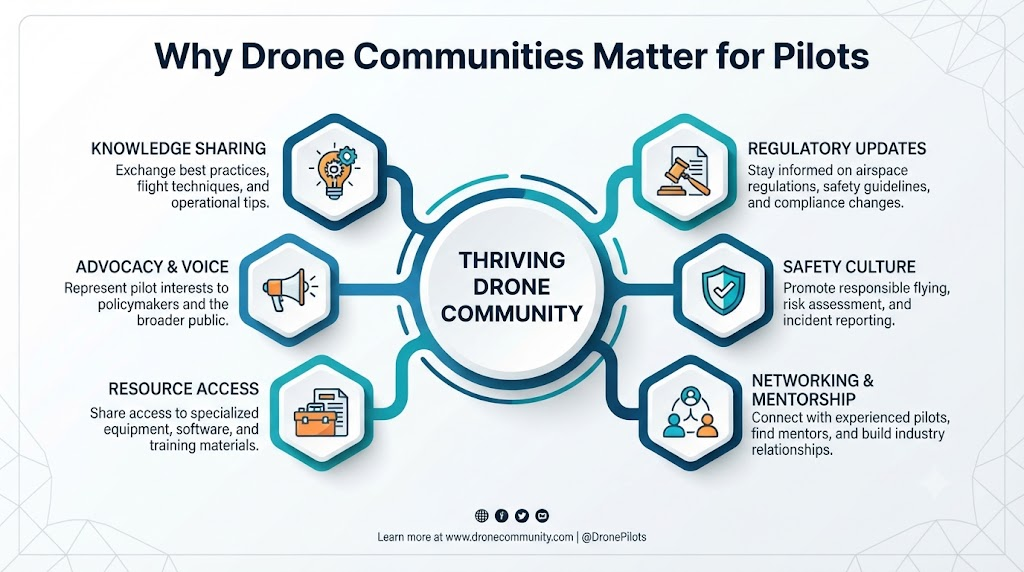
For someone stepping into the hobby or profession, the sheer volume of information can feel overwhelming. Battery chemistry, firmware versions, airspace classifications, and camera exposure settings demand attention long before the aircraft ever leaves the ground. Participating in a dedicated drone flying community helps beginners navigate this steep learning curve safely. Instead of guessing how to handle crosswinds or how to properly storage-charge a lithium-polymer battery, new operators can learn directly from veterans who have already made—and survived—those early mistakes. Experienced members routinely help newcomers understand pre-flight checklists, routine maintenance habits, and basic troubleshooting steps. This mentorship prevents costly equipment damage and builds healthy operational habits from day one.
Learning from Real-World Pilot Experiences
No manufacturer manual can fully prepare an operator for every unexpected variable encountered in the field. Real flight environments introduce sudden wind shears, localized electromagnetic interference, unexpected signal drops, and challenging lighting conditions. Within active drone forums, pilots routinely share candid accounts of challenging missions. They discuss how their aircraft reacted during sudden thermal updrafts, how specific camera filters performed in harsh coastal glare, or how firmware updates altered return-to-home behavior. This sharing of practical wisdom offers invaluable context. However, responsible operators always remember that community anecdotes supplement, but never replace, official manufacturer guidelines and flight manuals.
Prioritizing Safety and Responsible Flying
Aviation safety remains the absolute cornerstone of uncrewed flight. As airspace becomes more crowded, individual accountability directly affects the entire sector. A mature drone pilot network acts as a collective safety guardrail. Members regularly discuss safety incidents, analyze close calls, and share strategies for maintaining visual line of sight. Healthy communities actively discourage reckless stunts, dangerous over-people flights, or provocative social media challenges. Instead, they foster a culture of risk mitigation, encouraging pilots to evaluate weather, check airspace advisories, and respect public privacy before every single takeoff.
Navigating Regulations and Staying Informed
Aviation regulations govern where, when, and how unmanned aircraft can operate. Because these legal frameworks evolve alongside advancing technology, staying compliant requires continuous attention. While community discussions can alert members to emerging regulatory shifts, every pilot holds personal responsibility for verifying the law. For operations in India, pilots must stay fully aligned with the Directorate General of Civil Aviation (DGCA) and the Digital Sky platform requirements. Community peers can help clarify how to navigate portal registrations or flight permission workflows, but final legal compliance always rests with the individual operator on site.
Troubleshooting and Technical Problem Solving
Technical glitches inevitably happen in technology-driven fields. A gimbal might twitch unexpectedly, a GPS module might struggle to lock onto satellites, or a mobile ground control application might freeze mid-flight. When technical hurdles arise, searching through collective drone pilot resources often points toward a fast solution. Peers who encountered identical error codes weeks prior can frequently guide troubleshooting steps, whether it involves compass calibration routines, cache clearing, or firmware rollbacks. For deep hardware failures, community members help distinguish between minor software fixes and issues that demand professional manufacturer repair.
Exploring Equipment Beyond the Spec Sheet
Manufacturers naturally highlight peak performance numbers in their marketing materials. Maximum flight times, wind resistance ratings, and sensor resolutions look impressive on paper, but field performance can tell a different story. Engaging with experienced drone enthusiasts gives prospective buyers an unvarnished look at how hardware behaves over months of heavy use. Discussions frequently cover real-world battery degradation, controller ergonomics in cold weather, payload mounting limits, and spare parts availability. This grounded perspective helps operators select equipment tailored to actual mission requirements rather than flashy advertising claims.
Expanding Horizons Across Different Use Cases
Many pilots begin their journey with recreational photography, unaware of the vast commercial landscape operating just beyond their horizon. A diverse drone ecosystem exposes hobbyists to specialized industry applications. Members learn how thermal sensors assist in solar panel inspections, how multispectral cameras optimize crop health mapping, and how photogrammetry software turns overlapping aerial images into accurate 3D site models. Observing these advanced workflows often inspires pilots to expand their skills, acquire specialized certifications, and explore new professional avenues.
Networking and Professional Growth
Building connections within the aviation sector opens doors to professional collaboration. While joining a network does not automatically guarantee paid commercial projects or full-time employment, it creates visibility. Professional outcomes depend heavily on an individual’s verified skills, legal certifications, flight hours, and local market demand. Nevertheless, networking allows operators to find co-pilots for large mapping projects, share operational advice, find reliable subcontractors, and stay informed about emerging industry trends.
The Value of Mentorship in Aviation
Formal training provides the legal foundation for flying, but mentorship offers nuance. Experienced mentors teach situational awareness, client communication etiquette, and operational risk management. Mentorship within a community does not require formal contracts. It often happens organically when a veteran answers a detailed question on a forum, reviews a beginner’s aerial footage constructively, or demonstrates proper pre-flight protocol during a local meetup. These small interactions shape safer, more competent aviators.
Sustaining Professional Standards for Experienced Pilots
Experienced commercial operators also draw continuous value from peer networks. Even seasoned professionals encounter novel operational challenges, new regulatory interpretations, or software integration hurdles. Sharing workflows with other enterprise operators helps veterans refine efficiency, adopt better data-processing pipelines, and evaluate emerging payloads. Communities ensure that learning does not stop the day a commercial license arrives.
Balancing Formal Training and Community Wisdom
Structured instruction remains indispensable. Ground school and practical flight training teach airspace rules, emergency procedures, and aircraft aerodynamics in a controlled environment. A community complements this formal education by providing ongoing dialogue and diverse perspectives. Pilots must never substitute informal forum advice for required regulatory certification, ensuring that structured training always forms the backbone of their professional credentials.
Charting Career Paths in the Drone Industry
The modern aviation economy supports a wide array of specialized career roles. Beyond piloting, the industry demands mapping specialists, data processing technicians, agricultural drone operators, and maintenance engineers. Discussions within a drone industry community help newcomers understand the day-to-day realities of these roles. By observing what different careers require, aspiring professionals can target the specific technical skills and software proficiencies needed in the job market.
The Art of Sharing Constructive Flight Experiences
A healthy community thrives on honest, detailed sharing. When pilots recount a difficult flight, successful missions and close calls alike provide teachable moments for everyone. Effective community posts offer context regarding weather conditions, aircraft configuration, and decision-making processes, rather than simply labeling a piece of equipment or a maneuver as good or bad. Detailed case studies elevate the collective knowledge base of the entire group.
Filtering Information for Maximum Reliability
Online spaces host opinions ranging from expert advice to unverified speculation. Developing critical evaluation skills is vital for every pilot. Members should look for clear technical explanations, verifiable data, and alignment with official documentation. Cross-referencing community tips with manufacturer manuals and aviation authority guidelines ensures that pilots act on facts rather than assumptions.
Cultivating Responsible Community Etiquette
Positive interactions depend on mutual respect, constructive feedback, and privacy awareness. Responsible operators protect sensitive client data, respect private property boundaries, and avoid sharing coordinates of restricted or sensitive installations.
Healthy digital spaces prioritize education, safety, and supportive collaboration over reckless competition or risky flying stunts.
Comparing Isolated Learning and Community Engagement
| Feature | Isolated Self-Learning | Community-Supported Learning |
| Learning Resources | Limited to manuals and personal experiments | Access to shared guides, collective troubleshooting, and peer insights |
| Practical Experience | Gained entirely through trial and error | Accelerated by learning from others’ past mistakes and successes |
| Troubleshooting | Slower problem resolution during technical glitches | Faster identification of common bugs and hardware fixes |
| Networking | Minimal exposure to other operators | Direct connections to peers, mentors, and industry specialists |
| Safety Discussions | Self-evaluated risk assessment | Broad exposure to diverse safety perspectives and incident reviews |
| Career Awareness | Limited to individual job searches | Broader visibility into emerging roles and industry use cases |
Neither approach stands alone as universally superior; combining structured self-study with active peer collaboration delivers the most balanced skill development.
Contributing as a New Community Member
Newcomers often hesitate to participate, believing they lack sufficient experience. In reality, active engagement welcomes fresh perspectives.
Beginners can contribute by asking thoughtful questions, documenting their learning milestones, sharing resources, and supporting fellow novices. Every active participant adds value to the shared environment.
Choosing Between Online and Local Communities
Digital forums and chat platforms excel at providing rapid troubleshooting, global reach, and flexible communication across time zones. Conversely, local flying clubs and regional workshops offer hands-on collaboration, face-to-face mentorship, and direct observation of aircraft handling in local weather conditions. Utilizing both formats creates a well-rounded support system.
Engaging with the Broader DronesNow Ecosystem
Navigating the aviation landscape becomes simpler when resources are centralized. DronesNow unites pilots, verified equipment specifications, training resources, and active discussions into a single cohesive platform.
By connecting operators with educational hubs and community conversations, the platform helps aviation enthusiasts explore every facet of the drone ecosystem without getting lost in fragmented internet searches.
Maximizing Value Through Active Participation
Extracting real benefit from a network requires intentional engagement. Pilots should ask clear questions, verify technical answers against official documentation, contribute constructive feedback, and maintain professional courtesy. Avoiding unverified rumors ensures that participation remains a productive part of an aviator’s routine.
Avoiding Common Community Pitfalls
While networks offer immense value, operators must remain mindful of typical missteps. Blindly following unverified advice, attempting risky maneuvers seen online, treating anonymous forum claims as certified law, and sharing private operational data can create serious legal and safety hazards. Maintaining independent judgment protects both the pilot and the public.
Looking Ahead at the Evolution of Drone Communities
As uncrewed aviation expands into complex urban air mobility, autonomous BVLOS (Beyond Visual Line of Sight) operations, and advanced data analytics, collaborative networks will grow even more vital. Knowledge sharing, cross-industry cooperation, and ongoing pilot education will continue driving the safe expansion of the global drone economy.
Frequently Asked Questions
What defines a drone community?
A drone community is a connected network of beginners, hobbyists, commercial operators, trainers, and technicians who share knowledge, discuss equipment, exchange safety practices, and collaborate within the aviation ecosystem.
How do beginner pilots benefit from joining a community?
Beginners gain access to practical tips on battery care, pre-flight checks, basic troubleshooting, and weather evaluation, helping them avoid common mistakes during their initial flights.
Can online drone communities help with career development?
Yes, by exposing members to different industry use cases, specialized applications, and peer networks, communities help individuals understand the skills required for various professional drone roles.
Should community advice replace official manufacturer manuals?
Never. Community discussions provide valuable real-world perspectives, but official manufacturer instructions and aviation guidelines must always take precedence for safety and compliance.
How do professional drone pilots utilize community platforms?
Experienced operators use communities to discuss emerging workflows, evaluate new hardware performance, explore regulatory changes, and find collaborators for complex commercial missions.
Are all tips shared in online drone forums reliable?
Not necessarily. Online spaces contain varying experience levels, so pilots should always cross-reference technical claims with official documentation and manufacturer specifications.
What is the difference between local clubs and online forums?
Online forums offer global reach and rapid troubleshooting across time zones, while local clubs provide face-to-face interaction, hands-on mentorship, and localized flight practice.
How does DronesNow support drone pilots and operators?
DronesNow brings together certified pilot profiles, training partner resources, verified equipment specifications, and community discussions into a single flight-ready platform.
What privacy precautions should pilots practice within communities?
Pilots should avoid sharing sensitive flight coordinates, private property details, client project files, or personal identification data that could compromise operational security or privacy.
How can a new pilot become a helpful community member?
New pilots can contribute by asking clear questions, sharing honest accounts of their learning milestones, treating fellow members respectfully, and helping other beginners navigate their early flights.
Conclusion
As the uncrewed aviation sector continues to expand into complex commercial applications, autonomous flight operations, and advanced data analytics, the role of collaborative networks becomes increasingly vital. Becoming a skilled aviator involves far more than simply purchasing equipment and studying flight manuals; true proficiency grows through continuous learning, shared real-world experiences, strict safety awareness, and active engagement with fellow operators. By connecting with other pilots, sharing honest lessons, and utilizing centralized platforms like DronesNow to access training resources, equipment insights, and community discussions, operators at every stage can navigate the evolving drone ecosystem with confidence, safety, and professional growth.
