
Introduction
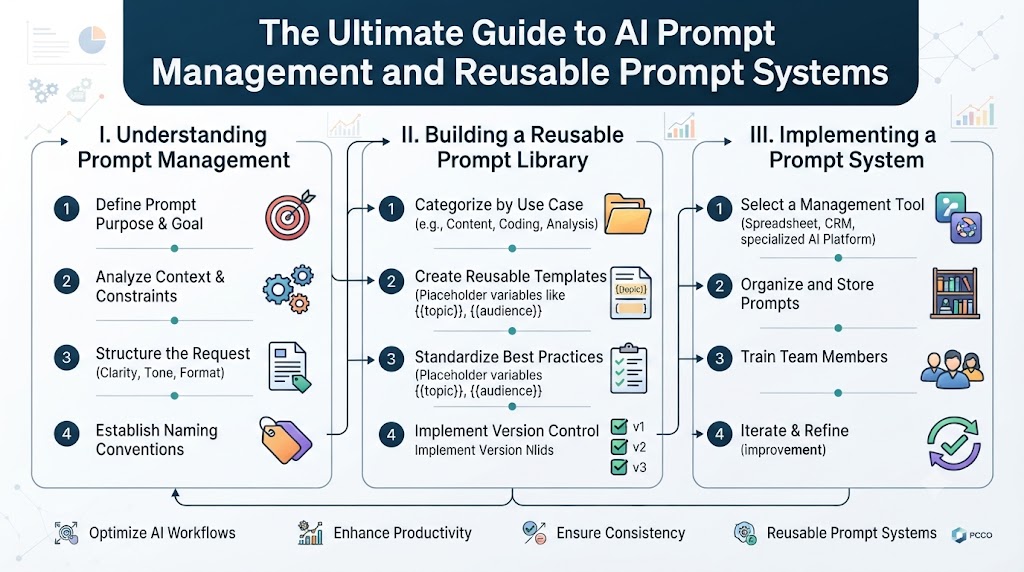
As artificial intelligence becomes a core driver of modern productivity, the ability to communicate effectively with large language models has evolved into an essential skill. Today, artificial intelligence prompts matter more than ever because they bridge human intent and machine execution, dictating the quality, accuracy, and relevance of AI-generated outputs. However, as individuals and teams scale their AI usage, managing effective prompts presents a significant operational challenge. Precious hours are lost searching through chat history, rewriting inconsistent instructions, and failing to track which version of a prompt produced the best results. Implementing a reusable prompt system solves this chaos by turning disparate text strings into valuable, structured digital assets. Throughout this comprehensive guide, readers will learn the fundamentals of prompt engineering, how to build an organized Prompt Library, and how modern platforms streamline AI workflows for maximum efficiency and consistent results.
What Is an AI Prompt Management Tool?
Definition
An AI prompt management tool is a centralized digital workspace designed to help users create, store, organize, edit, test, and share prompts for large language models and generative AI applications. Instead of scattering instructions across local text files or endless chat logs, these platforms centralize prompt assets for rapid retrieval and team collaboration.
Why Prompt Management Matters
As reliance on generative AI grows, prompts cease to be simple questions and become complex code-like instructions embedded with logic, constraints, and dynamic variables. Without proper management, teams suffer from redundant work, inconsistent output quality, and a lack of standardized brand voice. Proper management ensures that institutional knowledge is preserved and easily accessible.
Common Prompt Challenges
- Prompt Sprawl: Storing hundreds of valuable prompts across multiple personal accounts and messaging applications.
- Lack of Version Control: Inability to track modifications, making it difficult to revert when an update breaks a prompt’s performance.
- Collaboration Silos: Team members reinventing the wheel instead of sharing high-performing prompts across departments.
- Variable Inconsistency: Manual copy-pasting of messy text inputs without standardized placeholders.
Benefits of Organized Prompt Libraries
Utilizing a dedicated AI prompt management tool brings structure to your generative workflows. An organized AI prompt library accelerates task execution, ensures output predictability, eliminates redundant trial-and-error, and establishes a reliable foundation for scaling AI integration across individuals, startups, and enterprise teams.
Understanding Prompt Engineering
What Prompt Engineering Is
Prompt engineering is the iterative practice of structuring, refining, and optimizing text instructions so that generative AI models reliably produce accurate, safe, and contextually relevant outputs. According to foundational guidance from OpenAI documentation, clear communication, constraints, and structural formatting significantly enhance model performance.
Prompt Components
A robust prompt is rarely a single sentence. Professional prompts typically break down into modular sections:
- Role/Persona: Defining who the AI is acting as (e.g., an expert financial analyst).
- Context: Providing background information, target audience, or scenario specifics.
- Instructions: Explicit, step-by-step directives detailing what tasks need to be performed.
- Variables: Dynamic placeholders (like
{{topic}}or{{target_audience}}) that make templates reusable. - Constraints: Guardrails specifying what the model should not do or formatting limitations.
- Output Formatting: Clear guidelines on whether results should be a markdown table, bulleted list, or JSON object.
Practical Example
Consider a poorly written prompt: “Write about marketing.”
Compared to an engineered prompt: “Act as an expert digital marketing strategist. Write a 300-word introduction about $topic$ targeting $audience$. Format the response in clear paragraphs using active voice.” Using a robust prompt engineering platform helps turn vague ideas into structured engines of productivity.
Building an Organized AI Prompt Library
Categories
Grouping prompts by department, use case, or project—such as content creation, software development, data analysis, or customer support—ensures swift navigation through extensive collections.
Tags
Granular metadata tags allow users to filter prompts by difficulty, AI model compatibility, tone, or specific formatting requirements.
Variables
Dynamic input variables transform static text blocks into scalable templates, allowing users to inject custom data points instantly without rewriting core instructions.
Search
Advanced semantic and keyword search functionality ensures that creators can locate a specific prompt within milliseconds, even across vast corporate repositories.
Prompt Collections
Curated folders or playlists allow teams to bundle complementary prompts together for multi-step workflows, such as a content-creation pipeline from ideation to final editing.
Prompt Reusability
As highlighted in resources from Anthropic documentation, building modular prompts maximizes efficiency. Utilizing an AI prompt organizer ensures that successful prompts become permanent, reusable assets rather than ephemeral chat interactions.
AI Prompt Optimization
Improving Prompt Clarity
Clarity eliminates cognitive friction for the AI model. Removing ambiguous adjectives and replacing them with explicit instructions ensures the model understands exact user intent.
Better Instructions
Structuring prompts with numbered steps or logical sequences dramatically reduces hallucination rates and keeps responses focused on the objective.
Output Consistency
Optimized prompts yield repeatable results across multiple executions, which is essential for automated pipelines and programmatic workflows.
Role Definition
Assigning explicit personas aligns the model’s tone, vocabulary, and analytical depth with the desired professional standard.
Context Enhancement
Supplying necessary background information prevents the model from making flawed assumptions about the user’s environment or goals.
Reducing Ambiguity
Eliminating open-ended loopholes ensures the model addresses the exact core problem without drifting into irrelevant tangents. Running prompts through an AI prompt optimizer helps refine raw concepts into highly polished directives.
AI Prompt Analysis
Prompt Structure
Analyzing whether a prompt follows logical architectural patterns—such as separating instructions from context using clear markdown delimiters.
Goal Identification
Verifying that the core objective is explicitly stated and that secondary goals do not dilute the primary directive.
Variable Detection
Scanning templates to ensure all dynamic parameters are properly bracketed and easy for users to populate.
Output Expectations
Ensuring that length, format, tone, and structural requirements are clearly communicated to the model.
Safety Considerations
Reviewing prompts for potential biases, unintended harmful outputs, or security vulnerabilities before deployment.
Prompt Quality Evaluation
Leveraging an AI prompt analyzer allows users to dissect structural weaknesses, identify missing context, and measure systemic efficiency before deploying prompts in production.
Prompt Quality Checking
Clarity
Evaluating whether the instructions can be interpreted in only one correct way by both human users and AI models.
Context
Checking if sufficient background data has been supplied to anchor the output in reality.
Structure
Assessing whether markdown headings, bullet points, and delimiters are utilized to segment prompt sections cleanly.
Reusability
Determining whether the prompt is flexible enough to handle multiple variations through dynamic inputs.
Safety
Validating that the prompt adheres to safety guidelines and ethical generative AI practices.
Practical Value
Measuring the utility of the resulting output against real-world productivity goals.
Scoring Systems
Employing a dedicated prompt quality checker provides objective metrics and scoring dashboards that empower teams to continuously elevate their prompt craftsmanship.
Version Control for AI Prompts
Why Version History Matters
Prompts are living documents. As AI models update their underlying architectures—such as transitions documented in Google AI documentation—prompt behaviors shift. Version control ensures you never lose a working iteration.
Prompt Evolution
Tracking how a prompt evolves from a rough concept into a refined enterprise template over dozens of incremental edits.
Team Collaboration
Allowing multiple contributors to propose improvements, review changes, and merge optimized prompt variants seamlessly.
Tracking Improvements
Comparing historical performance metrics to confirm whether recent edits genuinely improved output quality or introduced regressions.
Managing Experiments
Running side-by-side evaluations using a prompt version control tool to identify the optimal iteration for specific business tasks.
Testing AI Prompts
Comparing Outputs
Evaluating how different phrasing or model parameters alter the tone, length, and factual accuracy of generated responses.
Measuring Consistency
Running identical prompts multiple times to check for variance and reliability in critical automated workflows.
A/B Prompt Testing
Testing two distinct prompt variants side by side to determine which instruction set delivers superior performance.
Prompt Experiments
Executing systematic trials across different parameters to optimize execution speed and token efficiency.
Community Evaluation
Sharing prompt tests across teams to gather qualitative feedback and diverse perspectives. Utilizing an AI prompt testing tool helps eliminate guesswork through empirical validation.
Reusable AI Prompt Templates
- Writing: Templates for drafting blog posts, email newsletters, whitepapers, and creative stories with consistent brand voice.
- Coding: Reusable instructions for code refactoring, bug fixing, documentation generation, and unit test writing.
- Marketing: Structured frameworks for ad copy creation, SEO optimization audits, social media calendars, and campaign briefs.
- Customer Support: Standardized response templates for ticket resolution, FAQ generation, and sentiment analysis.
- Research: Prompts for literature reviews, data synthesis, trend analysis, and executive summaries.
- Education: Frameworks for curriculum design, quiz generation, grading rubrics, and interactive tutoring.
- Business: Prompts for strategic planning, meeting summaries, SWOT analyses, and financial forecasting.
- Productivity: Templates for task prioritization, time-blocking schedules, and project kickoff outlines.
Promptosia for Different User Types
Writers
Writers use Promptosia to maintain consistent tone, organize research briefs, and instantly access headline generators and outline templates.
Developers
Developers store code-generation prompts, architectural review templates, and API debugging assistants in a shared repository.
Marketers
Marketers coordinate campaign copy, brand guidelines, and multi-channel content workflows using centralized prompt collections.
Students
Students leverage structured study prompts, essay-planning templates, and complex concept-simplification frameworks.
Researchers
Researchers organize academic literature synthesis prompts, citation formats, and rigorous data-extraction templates.
Educators
Educators build lesson-plan prompts, quiz generators, and personalized student feedback structures.
Businesses
Enterprises standardize internal AI adoption, ensuring secure, compliant, and efficient prompt usage across all departments.
Content Creators
Creators streamline scriptwriting, social media repurposing, and content ideation pipelines using reusable assets.
Agencies
Agencies collaborate seamlessly with clients by sharing standardized prompt passports and proven creative workflows.
AI Professionals
AI engineers utilize advanced version control, prompt analysis, and systematic A/B testing to refine production pipelines.
Best Practices for Prompt Management
- Save successful prompts: Immediately archive prompts that yield exceptional results into your central library.
- Organize by category: Group assets logically to maintain a clean and scalable repository.
- Use descriptive titles: Name prompts clearly so team members understand their exact function at a glance.
- Add variables: Build flexibility into your prompts using dynamic placeholders.
- Test regularly: Re-evaluate prompt performance whenever underlying AI models receive updates.
- Maintain version history: Track every iteration to understand how adjustments impact output quality.
- Improve continuously: Refine prompts based on real-world usage data and peer feedback.
- Document successful workflows: Pair prompts with contextual notes explaining how and when to use them.
Common Prompt Engineering Mistakes
- Vague instructions: Using overly broad language that leaves too much room for model interpretation.
- Missing context: Failing to provide necessary background details, leading to generic or inaccurate answers.
- Overly long prompts: Combining too many unrelated objectives into a single monolithic instruction block.
- Poor formatting: Neglecting markdown structure, making it difficult for the model to parse distinct sections.
- Lack of testing: Deploying prompts without empirical evaluation across multiple model runs.
- No version tracking: Overwriting successful prompts and losing the ability to revert changes.
- Ignoring prompt optimization: Settling for initial rough drafts instead of iteratively refining prompt clarity. As outlined in Microsoft Learn AI guidance, structured design patterns are vital for avoiding these common pitfalls.
Comparison Table
| Feature | Manual Prompt Storage | Promptosia |
| Organization | Scattered files & chat logs | Centralized Prompt Library |
| Version Control | None (Risk of overwriting) | Robust Version History |
| Search | Manual scrolling & guessing | Instant semantic & keyword search |
| Testing | Ad-hoc copy-pasting | Systematic Prompt Testing |
| Quality Analysis | Subjective guesswork | Automated Prompt Analyzer |
| Collaboration | Difficult and siloed | Real-time team sharing and Prompt Duels |
The Future of Prompt Engineering
As generative intelligence matures, prompt engineering is shifting from an ad-hoc art form into a rigorous discipline. Evergreen trends point toward automated prompt optimization, collaborative team ecosystems, standardized prompt marketplaces, and seamless workflow automation. Treating prompts as valuable digital assets ensures that organizations remain adaptable, efficient, and ready to leverage next-generation AI advancements without friction.
How Promptosia Helps Users Build Better Prompts
Promptosia provides a comprehensive ecosystem designed to elevate your AI interactions. Through its centralized Prompt Library, users can store and categorize assets effortlessly. Built-in optimization utilities refine clarity, while the Prompt Analyzer and quality checkers ensure high standards before execution. Version management tracks every iteration, and robust testing features allow for side-by-side comparisons using Prompt Duels. By combining Prompt Passports with community sharing, Promptosia empowers individuals and teams to build sustainable, high-performing AI workflows.
Frequently Asked Questions (FAQ)
What is an AI prompt management tool?
An AI prompt management tool is a dedicated software platform that allows individuals and teams to create, store, organize, optimize, and version-control their artificial intelligence prompts in a centralized digital workspace, replacing messy chat histories and scattered text documents.
Why should I save AI prompts?
Saving successful AI prompts saves valuable time, ensures consistent output quality across multiple sessions, preserves institutional knowledge, and allows you to build reusable templates rather than reinventing instructions for repetitive tasks.
What is prompt engineering?
Prompt engineering is the strategic practice of structuring, refining, and formatting text instructions and contextual variables so that generative AI models produce accurate, reliable, and contextually relevant responses tailored to specific user goals.
How does prompt optimization work?
Prompt optimization involves analyzing raw instructions for ambiguity, enhancing clarity, defining precise roles, adding appropriate context, and structuring constraints to eliminate model hallucinations and improve output consistency.
Why is prompt testing important?
Prompt testing is essential because slight variations in phrasing, context, or parameters can drastically alter AI outputs. Systematic testing ensures your prompts perform reliably across multiple model runs and diverse use cases.
What is prompt version control?
Prompt version control is the systematic tracking of changes made to a prompt over time. It allows users to review past iterations, compare performance metrics, and instantly revert to earlier versions if an update reduces output quality.
How does an AI prompt analyzer help?
An AI prompt analyzer evaluates structural integrity, goal clarity, variable implementation, and potential safety considerations, providing actionable insights that help users refine their prompts before deployment.
What makes a high-quality prompt?
A high-quality prompt features clear instructions, an explicit role or persona, necessary background context, well-defined constraints, structured formatting guidelines, and flexible variables that support reliable reusability.
Can teams collaborate on prompt libraries?
Yes, modern platforms allow teams to share prompt libraries, review version histories together, propose collaborative edits, and maintain a standardized brand voice and workflow across entire organizations.
Who should use Promptosia?
Promptosia is designed for writers, developers, marketers, students, researchers, educators, business professionals, agencies, and anyone who relies on generative AI and wants to streamline their prompt management workflows.
Conclusion
Mastering AI interaction requires moving beyond chaotic chat logs and adopting structured, intentional workflows. By understanding the core principles of prompt engineering, implementing rigorous version control, and organizing assets into a centralized repository, creators and professionals can unlock the true potential of generative artificial intelligence. Effective prompt management eliminates redundant effort and transforms fleeting ideas into scalable digital assets. Explore Promptosia today to organize your prompts, optimize your workflows, and elevate the quality of your AI-driven projects.
